MCQ
The function $\text{f(x)}=1+|\cos\text{x}|$ is:
  • A
    Continuous no where.
  • Continuous everywhere.
  • C
    Not differentiable at $x = 0$
  • D
    Not differentiable at $\text{x}=\text{n}\pi,\text{n}\in\text{Z}.$
Answer

Correct option: B.
Continuous everywhere.
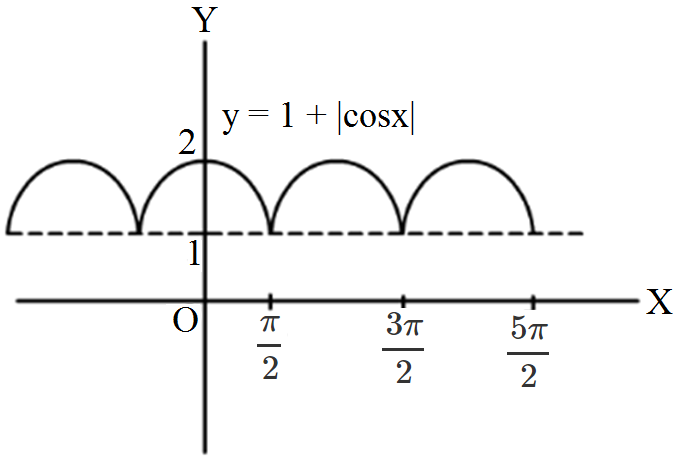
Graph of the function $\text{f(x)}=1+|\cos\text{x}|$ is as show blow:

From the graph, we can see that$ f(x)$ is everywhere continuous but not differentiable at $\text{x}=(2\text{n}+1)\frac{\pi}{2},\text{n}\in\text{Z}.$

Need a full question paper?

Generate a complete, print-ready paper with questions like this in minutes — across 16+ boards, with answer keys.

Start Generating Free

Similar questions

Which one of the following statements is not true:
If $\text{A}=\begin{bmatrix} 1 & 0 & 1 \\ 0 & 0 & 1 \\ \text{a} & \text{b} & 2 \end{bmatrix},$ then $aI + bA + 2 A^2$ equals:
If $f(x) = ({\log _{\cot x}}\tan x){({\log _{\tan x}}\cot x)^{ - 1}},$ then $f'(2) = $
Choose the correct answer from the given four options:
The maximum value of $\Big(\frac{1}{\text{x}}\Big)^\text{x}$ is:
Let $f: R \rightarrow R$ satisfy $f(x+y)=2^{x} f(y)+4^{y} f(x), \forall x$, $y \in R$. If $f(2)=3$, then $14 \cdot \frac{f^{\prime}(4)}{f^{\prime}(2)}$ is equal to
A computer producing factory has only two plants $T_1$ and $T_2$. Plant $T_1$ produces $20 \%$ and plant $T_2$ produces $80 \%$ of the total computers produced. $7 \%$ of computers produced in the factory turn out to be defective. It is known that

$P$ (computer turns out to be defective given that it is produced in plant $T_1$ )

$=10 P\left(\right.$ computer turns out to be defective given that it is produced in plant $\left.T_2\right)$,

where $P(E)$ denotes the probability of an event $E$. A computer produced in the factory is randomly selected and it does not turn out to be defective. Then the probability that it is produced in plant $T_2$ is

The derivative of $f(x) = x|x|$ is
Let a curve $y=y(x)$ be given by the solution of the differential equation

$\cos \left(\frac{1}{2} \cos ^{-1}\left(e^{-x}\right)\right) d x=\sqrt{e^{2 x}-1} \,d y$

If it intersects $y$-axis at $y=-1$, and the intersection point of the curve with $x$-axis is $(\alpha, 0)$ the $\mathrm{e}^{\alpha}$ is equal to $.....$

$\sec ({\rm{cose}}{{\rm{c}}^{ - 1}}x)$ is equal to
Solution of the differential equation $\frac{e^x-e^{-x}}{e^x+e^{-x}}=\frac{d x-d y}{d x+d y}$, is