MCQ
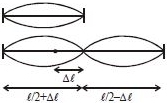
The fundamental frequency of a sonometer wire of length $l$ is $n_0$ . A bridge is now introduced at a distance of $\Delta l ( < < l)$ from the centre of the wire. The lengths of wire on the two sides of the bridge are now vibrated in their fundamental modes. Then, the beat frequency nearly is
  • A
    $n_0\ \Delta l/l$
  • $8\ n_0\ \Delta l/l$
  • C
    $2\ n_0\ \Delta l/l$
  • D
    $n_0\ \Delta l/2l$

Answer

Correct option: B.
$8\ n_0\ \Delta l/l$
b
Note that the beat frequency is $\left(\mathrm{n}_{1}-\mathrm{n}_{2}\right)$ and the corresponding vibrating lengths are $(\ell /2 - \Delta )$ and $(\ell /2 + \Delta \ell )$

Given $:{{\rm{n}}_0} = \frac{{\rm{V}}}{{2\ell }}$

$ \Rightarrow \frac{V}{\ell } = 2{n_0}$

$\mathrm{n}_{1}=\frac{\mathrm{V}}{2\left(\frac{\ell}{2}+\Delta \ell\right)}=\frac{\mathrm{V}}{\ell+2 \Delta \ell}$

$\mathrm{n}_{2}=\frac{\mathrm{V}}{2\left(\frac{\ell}{2}-\Delta \ell\right)}=\frac{\mathrm{V}}{\ell-2 \Delta \ell}$

Beat frequency $=\mathrm{n}_{2}-\mathrm{n}_{1}=\frac{\mathrm{V}}{\ell-2 \Delta \ell}-\frac{\mathrm{V}}{\ell+2 \Delta \ell}$

$=\frac{V}{\ell\left(1-\frac{2 \Delta \ell}{\ell}\right)}-\frac{V}{\ell\left(1+\frac{2 \Delta \ell}{\ell}\right)}$

$=\frac{V}{\ell}\left(1-2 \frac{\Delta \ell}{\ell}\right)^{-1}-\frac{V}{\ell}\left(1+2 \frac{\Delta \ell}{\ell}\right)^{-1}$

$=\frac{V}{\ell}\left(1+2 \frac{\Delta \ell}{\ell}\right)-\frac{V}{\ell}\left(1-2 \frac{\Delta \ell}{\ell}\right)\left[(1+x)^{n}=1+\operatorname{nx}\right]$

$=\frac{V}{\ell}+\frac{2 V}{\ell} \frac{\Delta \ell}{\ell}-\frac{V}{\ell}+\frac{2 V}{\ell} \frac{\Delta \ell}{\ell}$

$=2 \cdot 2 n_{0} \cdot \frac{\Delta \ell}{\ell}+2 \cdot 2 n_{0} \cdot \frac{\Delta \ell}{\ell}=8 n_{0}\left(\frac{\Delta \ell}{\ell}\right)$

Need a full question paper?

Generate a complete, print-ready paper with questions like this in minutes — across 16+ boards, with answer keys.

Start Generating Free

Similar questions

A current passes through a resistor. Let $\mathrm{K}_1$ and $\mathrm{K}_2$ represent the average kinetic energy of the conduction electrons and the metal ions, respectively:
A manometer connected to a closed tap reads $3.5 × 10^5 N/m^2$. When the valve is opened, the reading of manometer falls to $3.0 × 10^5 N/m^2$, then velocity of flow of water is ........ $m/s$
A jar has a mixture of hydrogen and oxygen gas in the ratio of $1 : 5$. The ratio of mean kinetic energies of hydrogen and oxygen molecules is
A large spherical mass $M$ is fixed at one position and two identical point masses $m$ are kept on a line passing through the centre of $M$ (see figure). The point masses are connected by a rigid massless rod of length $\ell$ and this assembly is free to move along the line connecting them. All three masses interact only through their mutual gravitational interaction. When the point mass nearer to $M$ is at a distance $r =3 \ell$ from $M$, the tension in the rod is zero for $m=k\left(\frac{M}{288}\right)$. The value of $k$ is
The equation of a longitudinal wave is represented as $y = 20\cos \pi (50t - x)$. Its wavelength is ..... $cm$
The velocities of three particles of masses $20\ g$, $30\ g$ and $50\ g$ are $10 \vec i,\,10\vec j,\,{\rm{and}}\,10\vec k$ respectively. The velocity of the centre of mass of the three particles is
A cylinder of radius $R$ is surrounded by a cylindrical shell of inner radius $R$ and outer radius $2R$. The thermal conductivity of the material of the inner cylinder is $K_1$ and that of the outer cylinder is $K_2$. Assuming no loss of heat, the effective thermal conductivity of the system for heat flowing along the length of the cylinder is
A ladder $AP$ of length $5\,\, m$ is inclined to a vertical wall is slipping over a horizontal surface with velocity of $2\,\, m/s,$ when $A$ is at a distance $3\ m$ from ground what is the velocity of $C.M.$ at this moment   .......... $m/s$
In the figure a container is shown to have a movable (without friction) piston on top. The container and the piston are all made of perfectly insulating material allowing no heat transfer between outside and inside the container. The container is divided into two compartments by a rigid partition made of a thermally conducting material that allows slow transfer of heat. The lower compartment of the container is filled with $2$ moles of an ideal monatomic gas at $700 \ K$ and the upper compartment is filled with $2$ moles of an ideal diatomic gas at $400$

K. The heat capacities per mole of an ideal monatomic gas are $C_v=\frac{3}{2} \ R, C_p=\frac{5}{2} R$, and those for an ideal diatomic gas are $C _{ v }=\frac{5}{2} \ R , C _{ P }=\frac{7}{2} R$.

$1.$ Consider the partition to be rigidly fixed so that it does not move. When equilibrium is achieved, the final temperature of the gases will be :

$(A)$ $550 \ K$ $(B)$ $525 \ K$ $(C)$ $513 \ K$ $(D)$ $490 \ K$

$2.$ Now consider the partition to be free to move without friction so that the pressure of gases in both compartments is the same. Then total work done by the gases till the time they achieve equilibrium will be:

$(A)$ $250 \ R$ $(B)$ $200 \ R$ $(C)$ $100 \ R$ $(D)$ $-100 \ R$

Give the answer question $1$ and $2.$

A particle is projected in a plane perpendicular to a uniform magnetic field. The area bounded by the path described by the particle is proportional to: