MCQ
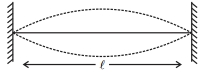
The fundamental frequency of vibration of a string stretched between two rigid support is $50\,Hz$. The mass of the string is $18\,g$ and its linear mass density is $20\,g / m$. The speed of the transverse waves so produced in the string is $..........\,ms ^{-1}$
  • $90$
  • B
    $45$
  • C
    $30$
  • D
    $15$

Answer

Correct option: A.
$90$
a
Fundamental frequency $=50\,Hz$

$\frac{mass}{length}$=$\frac{20 g}{m}$

mass$=18\,g$

length of string $=\frac{18}{20} m =\frac{9}{10} m$

from diagram $\frac{\lambda}{2}=\ell$

$\Rightarrow \lambda=2 \ell=\frac{9}{5}\,m$

again speed $v=f \lambda=50 \times \frac{9}{5}=90\,m / s$

Need a full question paper?

Generate a complete, print-ready paper with questions like this in minutes — across 16+ boards, with answer keys.

Start Generating Free

Similar questions

$Assertion$ : Retardation is directly opposite to the velocity.
$Reason$ : Retardation is equal to the time rate of decrease of speed.
Dimensions of coefficient of viscosity are
Which of the following physical quantities do not have same dimensions?
${\mu _0}$ and ${\varepsilon _0}$ denote the permeability and permittivity of free space, the dimensions of ${\mu _0}{\varepsilon _0}$ are
Absolute scale of temperature is reproduced in the laboratory by making use of a
Three bodies have equal masses $m$. Body $A$ is solid cylinder of radius $R$, body $B$ is a square lamina of side $R$, and body $C$ is a solid sphere of radius $R$. Which body has the smallest moment of inertia about an axis passing through their centre of mass and perpendicular to the plane (in case of lamina)
A rod of silver of $100\;cm$ is at $0^{\circ} C$ is heated to $100^{\circ} C$. Its length is increased by $0.19 \,cm .$ Coefficient of cubical expansion of the silver rod is
A particle of mass $m$ is projected at an angle $\alpha $ to the horizontal with initial velocity $u\,m/s$ then work done by gravity during the time it reaches its highest point
A rocket is fired upward from the earth's surface such that it creates an acceleration of $20\, m/s^2$. If after $5\, s$ its engine is switched off, the maximum height of the rocket  from the earth's surface would be......$m$
A ball is projected at an angle $45^o$ with horizontal. It passes through a wall of height $h$  at horizontal distance $d_1$ from the point of projection and strikes the ground at a  horizontal distance $(d_1 + d_2)$ from the point of projection, then $h$ is