Question
The game of billiards is played with balls placed on a rectangular table. One ball is struck with the
end of a stick, called a cue. The ball bounces into other balls and relects off the sides of the table. In a real game, the ball may spin, but for mathematical purposes, it is considered that the ball travels in a straight line with the same relection and incidence angles.
Image

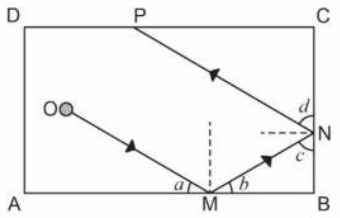
On a billiard table $ABCD,$ the ball placed at $O$ is struck with the cue.
$1.$ What is the value of $\angle a + \angle d?$
$2.$ Why is the line $OM$ parallel to $PN?$
Answer

$1. 90$
$90^\circ $
$2.$ Mathematically valid proof
● Let angles on line $AMB$ be $a, x$ and $b$ and angles on line $BNC$ be $c, y$ and $d.$
$x = 180 – (a + b) …..1$
$y = 180 – (c + d) …...2$
Adding $1$ and $2,$
$x + y = 360 – (a + b + c + d)$
$= 360 – (2a + 2c)$
$= 360 – 2 \times 90 = 180$
Thus, lines $OM$ and $NP$ are parallel.

Need a full question paper?

Generate a complete, print-ready paper with questions like this in minutes — across 16+ boards, with answer keys.

Start Generating Free

Similar questions

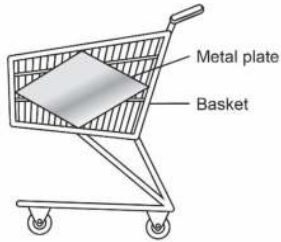
The figure below shows the side view of a shopping trolley. The metal plate is fixed on the side by the store keeper for advertisement.Image
$6.$ Three angles of the basket are obtuse. Which type of angle is the fourth$?$
$A.$ Acute
$B.$ Obtuse
$C.$ Right
$D.$ Relex
$7.$ What is the shape of the metal plate$?$
$A.$ Square
$B.$ ectangle
$C.$ Rhombus
$D.$ Parallelogram
Raju designs a hut for homeless people. The hut is a combination of a cuboid and a right cone. The top of the hut is a cone with radius $4\ m$ and height $1\ m$. It is made of economical material. The loor of the tent is covered with rugs.
The total height of the tent is $4.5\ m.$ The cuboidal part of the tent is $6\ m$ long and $5\ m$ wide.
$1.$ What is the outer surface area $($in $m^2)$ of the hut$?$
$A. 77$
$B. 77+4π√17$
$C. 137+4π√17$
$D. 137+4π(4+√17)$
$2.$ The length and width of a rug used for the loor are $2.6\ m$ and $2\ m$ respectively.
What is the minimum number of rugs required to cover the loor of the tent house$?$
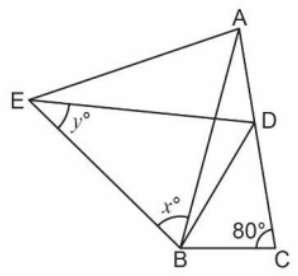
In the given figure, the isosceles triangle $ABC ≅ EAD.$ The point $E$ is equidistant from both $A$ and $B.$Image
$4.$ What is the value of $x?$
$A. 40^\circ $
$B. 60^\circ $
$C. 70^\circ $
$D. 80^\circ $
$5.$ What is the value of $y?$
$6.$ What is the value of $\angle BDC?$
$A. 30^\circ $
$B. 40^\circ $
$C. 50^\circ $
$D. 70^\circ $
Read the following text carefully and answer the questions that follow:
A teacher is a person whose professional activity involves planning, organizing, and conducting group activities to develop student's knowledge, skills, and attitudes as stipulated by educational programs. Teachers may work with students as a whole class, in small groups or one-to-one, inside or outside regular classrooms. In this indicator, teachers are compared by their average age and work experience measured in years.
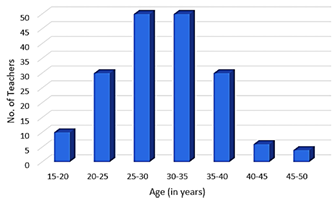
For the same in 2015, the following distribution of ages (in years) of primary school teachers in a district was collected to evaluate the teacher on the above-mentioned criterion.
Image
i. What is the total no of teachers?
ii. Find the class mark of class 15 - 20, 25 - 30 and 45 - 50?
iii. What is the no of teachers of age range 25 - 40 years?
OR
Which classes are having same no. of teachers?
A soap manufacturer makes fragrant and non-fragrant liquid soaps. The liquid soaps are illed in plastic bottles and packed in equal size cartons for transportation. Each carton contains $50$ bottles. The mass of a full bottle of soap is $220\ gm$ and that of a half$-$illed bottle is $120\ gm.$ What will be the mass $(gm)$ of the empty bottle$?$
Read the following text carefully and answer the questions that follow:
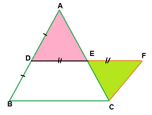
Haresh and Deep were trying to prove a theorem. For this they did the following
Image
$i.$ Draw a triangle $ABC$
$ii. \ D$ and E are found as the mid points of $AB$ and $AC$
$iii.\ DE$ was joined and $DE$ was extended to $F$ so $DE = EF$
$iv. \ FC$ was joined.
Questions :
$i. \triangle ADE$ and $\triangle EFC$ are congruent by which criteria?
$ii.$ Show that $C F \| A B$.
$iii.$ Show that $C F=B D$.
OR
Show that $D F=B C$ and $D F \| B C$.
Read the following text carefully and answer the questions that follow:
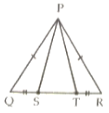
A children's park is in the shape of isosceles triangle said $\text{PQR}$ with $\text{PQ = PR, S}$ and $T$ are points on $\text{QR}$ such that $\text{QT = RS}$.
Image
$i.$ Which rule is applied to prove that congruency of $\ce{\triangle PQS}$ and $\ce{\triangle PRT}$.
$ii.$ Name the type of $\ce{\triangle PST.}$
$iii.$ If $\ce{PQ=6 \ cm}$ and $\ce{QR=7 \ cm}$, then find perimeter of $\ce{\triangle PQR}$.
OR
If $\ce{\angle QPR =80^{\circ}}$ find $\ce{\angle PQR}$ ?
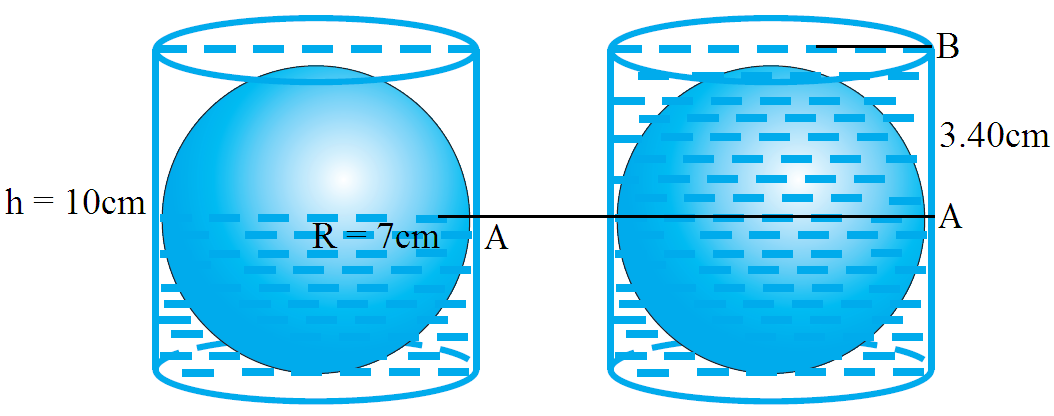
Read the passage given below and answer these questions: Dev was doing an experiment to find the radius $r$ of a sphere. For this he took a cylindrical container with radius $R = 7\ cm$ and height $10\ cm$. He filled the container almost half by water as shown in the left figure. Now he dropped the yellow sphere in the container. Now he observed as shown in the right figure the water level in the container raised from $A$ to $B$ equal to $3.40\ cm.$

$i.$ What is the approximate radius of the sphere?
$a. 7\ cm$
$b. 5\ cm$
$c. 4\ cm$
$d. 3\ cm$
$ ii.$ What is the volume of the cylinder?
$a. 700\ cm^3$
$b. 500\ cm^3$
$c. 1540\ cm^3$
$d. 2000\ cm^3$
$iii.$ What is the volume of the sphere?
$a. 700\ cm^3$
$b. 600\ cm^3$
$c. 500\ cm^3$
$d. 523.8\ cm^3$
$ iv.$ How many litres water can be filled in the full container? $($Take $1$ litre $= 1000\ cm^3):$
$a. 1.50$
$b. 1.44$
$c. 1.54$
$d. 2$
$v.$ What is the surface area of the sphere?
$a. 314.3\ m^2$
$b. 300\ m^2$
$c. 400\ m^2$
$d. 350\ m^2$
Read the Source/ Text given below and answer these questions:

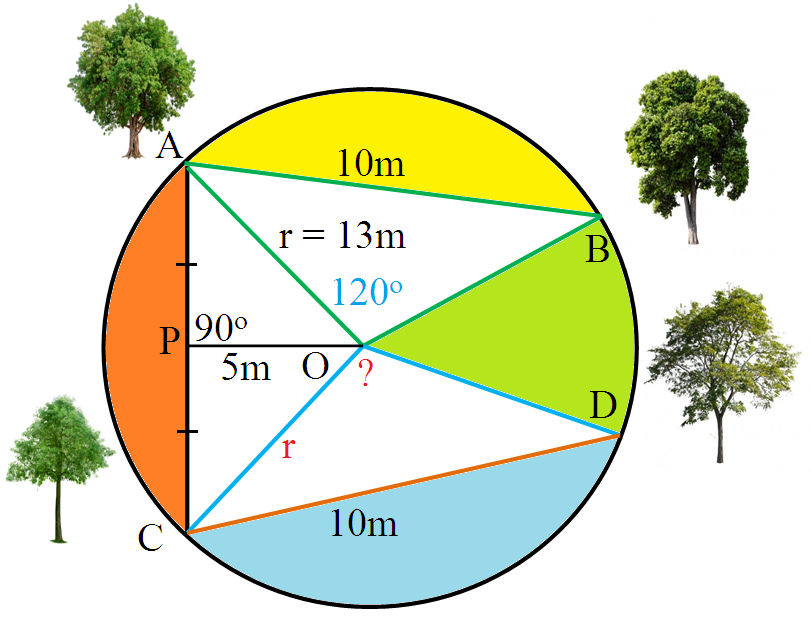
 A farmer has a circular garden as shown in the picture above. He has a different type of trees, plants and flower plants in his garden. In the garden, there are two mango trees $A$ and $B$ at a distance of $AB = 10m.$ Similarly, he has two Ashoka trees at the same distance of $10\ m$ as shown at $C$ and $D.\  AB$ subtends $\angle\text{AOB}=120^\circ$ at the center $O,$ The perpendicular distance of $AC$ from center is $5m$. The radius of the circle is $13\ m$. Now answer the following questions:
$i.$ What is the value of $\angle\text{COD}?$
$a. 60^\circ $
$b. 120^\circ $
$c. 100^\circ $
$d. 80^\circ $
$ii.$ What is the distance between mango tree $A$ and Ashok tree $C?$
$a. 12\ m$
$b. 24\ m$
$c. 13\ m$
$d. 15\ m$
$iii.$ What is the value of $\angle\text{OAB}?$
$a. 60^\circ $
$b. 120^\circ $
$c. 30^\circ $
$d. 90^\circ $
$iv.$ What is the value of $\angle\text{OCD?}$
$a. 30^\circ $
$b. 120^\circ $
$c. 60^\circ $
$d. 90^\circ $
$v.$ What is the value of $\angle\text{ODC}?$
$a. 90^\circ $
$b. 120^\circ $
$c. 60^\circ $
$d. 30^\circ $