Question
The given figure represents a material which is
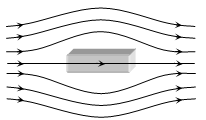
|
(a) Paramagnetic |
(b) Diamagnetic |
(c) Ferromagnetic |
(d) None of these |
The given figure represents a material which is
|
(a) Paramagnetic |
(b) Diamagnetic |
(c) Ferromagnetic |
(d) None of these |
(b) Diamagnetic
Generate a complete, print-ready paper with questions like this in minutes — across 16+ boards, with answer keys.
For the production of X-rays of wavelength 0.1 Å the minimum potential difference will be
|
(a) 12.4 kV |
(b) 24.8 kV |
(c) 124 kV |
(d) 248 kV |
To compare magnetic moments of two magnets by vibration magnetometer, 'sum and difference method' is better because
|
(a) Determination of moment of inertia is not needed which minimises the errors |
| (b) Less observations are required |
| (c) Comparatively less calculations |
| (d) All the above |
Assertion : The setting sun appears to be red.
Reason : Scattering of light is directly proportional to the wavelength.
|
(a) If both assertion and reason are true and the reason is the correct explanation of the assertion. |
|
(b) If both assertion and reason are true but reason is not the correct explanation of the assertion. |
|
(c) If assertion is true but reason is false. |
|
(d) If the assertion and reason both are false. |
The light rays having photons of energy 1.8 eV are falling on a metal surface having a work function 1.2 eV. What is the stopping potential to be applied to stop the emitting electrons
|
(a) 3 eV |
(b) 1.2 eV |
(c) 0.6 eV |
(d) 1.4 eV |
Which of the following theories is the most satisfactory about the origin of the universe
|
(a) Big Bang theory |
(b) Pulsating theory |
(c) Steady state theory |
(d) None of these |