Question
The given figure shows a square $\text{ABCD}$ and an equilateral $\triangle ABP.$
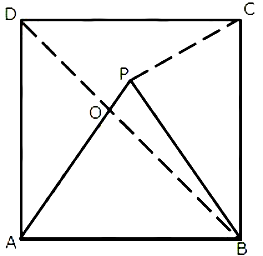

Calculate: $(i) \angle AOB;(ii) \angle BPC;(iii)\angle PCD;(iv)$ Reflex $\angle APC$
Answer


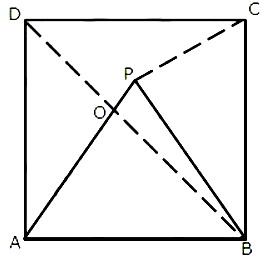
In the given figure $\triangle APB$ is an equilateral triangle.
Therefore all its angles are $60^{\circ}$
Again in the
$\triangle ADB$,
$\angle ABD =45^{\circ}$
$\angle AOB =180^{\circ}-60^{\circ}-45^{\circ}=75^{\circ}$
Again
$\triangle BPC$
$\Rightarrow \angle BPC =75^{\circ}\ldots .[$ Since $B P=C B]$
Now,
$\angle C =\angle BCP +\angle PCD$
$ \Rightarrow \angle PCD =90^{\circ}-75^{\circ}$
$ \Rightarrow \angle PCD =15^{\circ}$
Therefore,
$\angle APC =60^{\circ}+75^{\circ}$
$ \Rightarrow \angle APC =135^{\circ}$
$ \Rightarrow \text { Reflex } \angle APD =360^{\circ}-135^{\circ}=225^{\circ}$
$(i) \angle AOB =75^{\circ}$
$(ii) \angle BPC =75^{\circ}$
$(iii) \angle PCD =15^{\circ}$
$(iv)$ Reflex $\angle APC =135^{\circ}$.
Reflex $\angle APD =225^{\circ}$

Need a full question paper?

Generate a complete, print-ready paper with questions like this in minutes — across 16+ boards, with answer keys.

Start Generating Free