Question
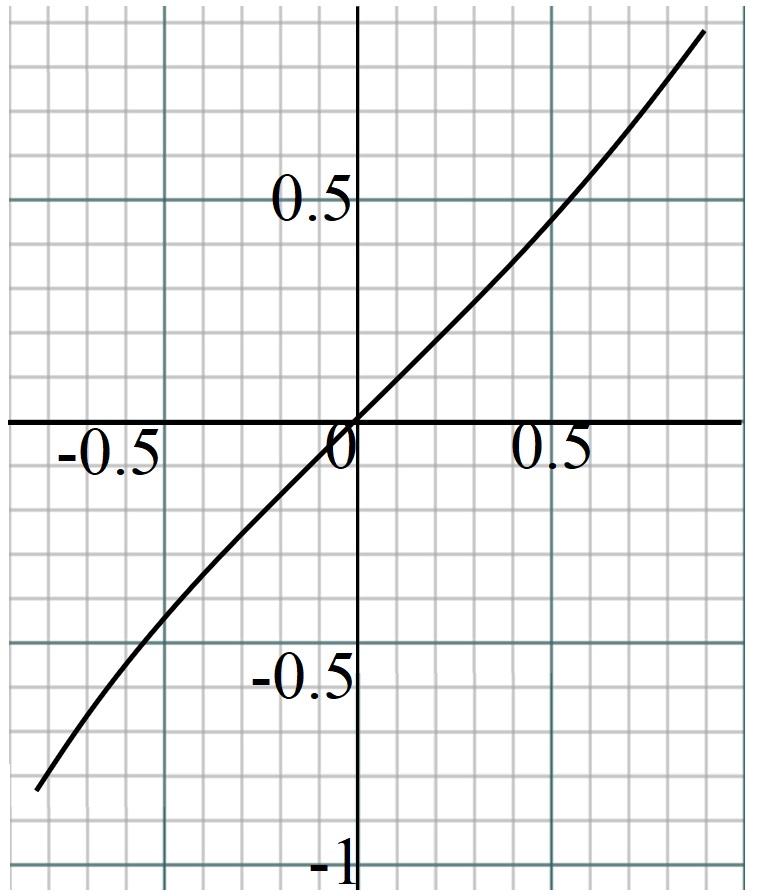
The given graph is for which equation?
  1. $\text{y}= \sin\text{x}$

  2. $\text{y} = \sin-1\text{x}$

  3. $\text{y} = \text{cosec }\text{x}$

  4. $\text{y} = \sec\text{x}$

Answer

  1. $\text{y} = \sin-1\text{x}$

Solution:

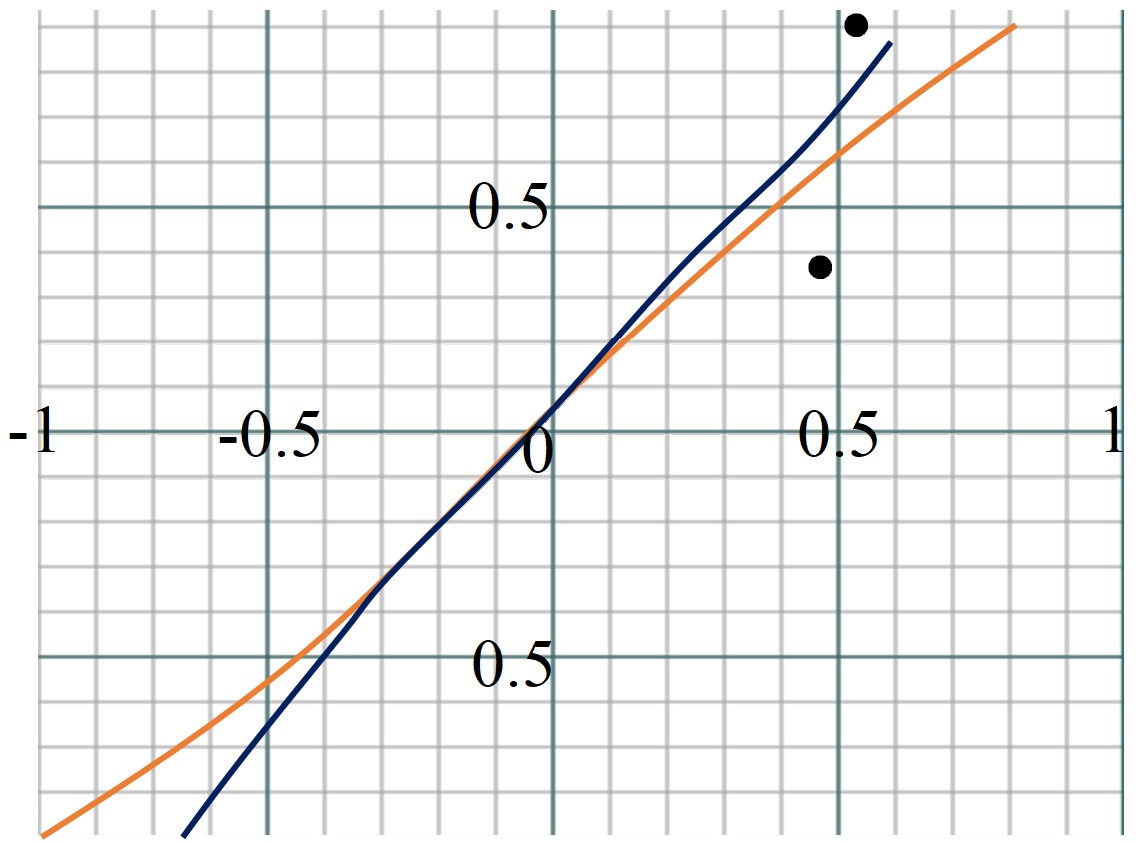
The following graph represents 2 equations.

The pink curve is the graph of $\text{y} = \sin\text{x}$

The blue curve is the graph for $\text{y} = \sin^{-1}{\text{x}}$

This curve passes through the origin and approaches to infinity in both positive and negative axes.

Need a full question paper?

Generate a complete, print-ready paper with questions like this in minutes — across 16+ boards, with answer keys.

Start Generating Free

Similar questions

If A is a skew symmetric matrix, then ∣A∣ is
  1. 1
  2. -1
  3. 0
  4. none
Let $f:\left[0, \frac{\pi}{2}\right] \rightarrow[0,1]$ be the function defined by $f(x)=\sin ^2 x$ and let $g:\left[0, \frac{\pi}{2}\right] \rightarrow[0, \infty]$ be the function defined by $g(x)=\sqrt{\frac{\pi x}{2}-x^2}$.

(There are two questions based on $PARAGRAPH "II"$, the question given below is one of them)

($1$) The value of $2 \int^{\frac{\pi}{2}} f(x) g(x) d x-\int^{\frac{\pi}{2}} g(x) d x$ us

($2$) The value of $\frac{16}{\pi^3} \int_0^{\frac{\pi}{2}} f(x) g(x) d x$ is

Give the answer or quetion ($1$) and ($2$) 

Let in a Binomial distribution, consisting of $5$ independent trials, probabilities of exactly $1$ and $2$ successes be $0.4096$ and $0.2048$ respectively. Then the probability of getting exactly $3$ successes is equal to ....... .
$\int {\frac{{{e^{{{\tan }^{ - 1}}x}}}}{{(1 + {x^2})}}\,\,\left[ {{{\left( {{{\sec }^{ - 1}}\,\sqrt {1 + {x^2}} } \right)}^2}\,\, + \,\,{{\cos }^{ - 1}}\,\left( {\frac{{1 - {x^2}}}{{1 + {x^2}}}} \right)} \right]} \,\,\,dx$ $(x > 0)$
The derivative of $\cos^{-1}(2\text{x}^2-1)$ with respect to $\cos^{-1}\text{x}$ is:
  1. $2$
  2. $\frac{1}{2\sqrt{1+\text{x}^2}}$
  3. $\frac{2}{\text{x}}$
  4. $1-\text{x}^2$
The feasible region for an LPP is shown shaded in the figure. Let $F=3 x-4 y$ be the objective function.
Maximum value of $F$ is
Image
For the function $\text{f}(\text{x})=\text{x}+\frac{1}{\text{x}}$
  1. x = 1 is a point of maximum.
  2. x = -1 is a point of minimum.
  3. maximum value > minimum value.
  4. maximum value < minimum value.
$\int_{}^{} {{{\tan }^{ - 1}}\frac{{2x}}{{1 - {x^2}}}dx = } $
Choose the correct answer from the given four options.
If the set A contains 5 elements and the set B contains 6 elements, then the number of one-one and onto mappings from A to B is:
  1. 720
  2. 120
  3. 0
  4. none of these.
The value of the determinant $\begin{vmatrix} 5 &\text{amp; } 1 \\ 3 &\text{amp; } 2 \end{vmatrix}$
  1. 4
  2. 5
  3. 6
  4. 7