MCQ
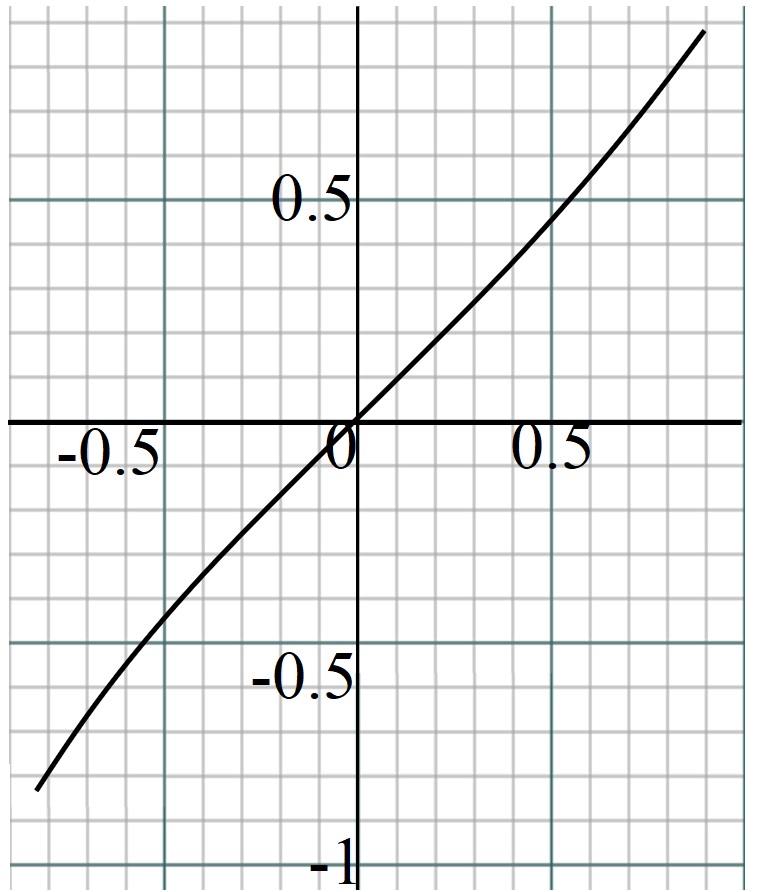
The given graph is for which equation?
  • A
    $\text{y}= \sin\text{x}$
  • $\text{y} = \sin-1\text{x}$
  • C
    $\text{y} = \text{cosec }\text{x}$
  • D
    $\text{y} = \sec\text{x}$

Answer

Correct option: B.
$\text{y} = \sin-1\text{x}$
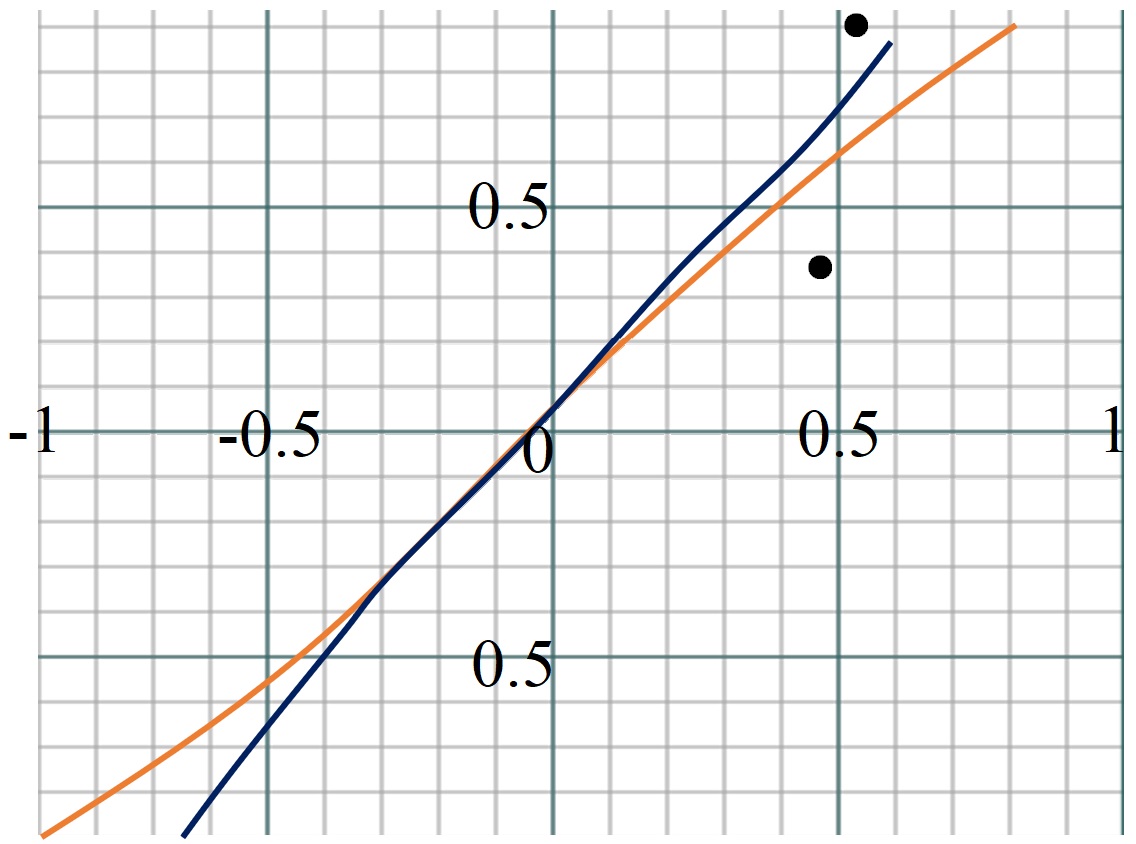
The following graph represents $2$ equations.

The pink curve is the graph of $\text{y} = \sin\text{x}$
The blue curve is the graph for $\text{y} = \sin^{-1}{\text{x}}$
This curve passes through the origin and approaches to infinity in both positive and negative axes.

Need a full question paper?

Generate a complete, print-ready paper with questions like this in minutes — across 16+ boards, with answer keys.

Start Generating Free

Similar questions

If $\text{y}^\frac{1}{\text{n}}+\text{y}-^\frac{1}{\text{n}}=2\text{x}$ then find $(\text{x}^2-1)\text{y}_2+\text{xy}_1=$
The projections of a vector on the three coordinate axis are $6, -3, 2$ respectively. The direction cosines of the vector are:
Let $\theta=\frac{\pi}{5}$ and $A=\left[\begin{array}{cc}\cos \theta & \sin \theta \\ -\sin \theta & \cos \theta\end{array}\right] \cdot$ If $B=A + A ^{4},$ then $\operatorname{det}( B )$
The area bounded by the curve $y = (x + 1)^2, y = (x - 1)^2$ and the line $y = 0$ is:
Let $\overrightarrow{P R}=3 \hat{i}+\hat{j}-2 \hat{k}$ and $\overrightarrow{S Q}=\hat{i}-3 \hat{j}-4 \hat{k}$ determine diagonals of a parallelogram $P Q R S$ and $\overrightarrow{P T}=\hat{i}+2 \hat{j}+3 \hat{k}$ be another vector. Then the volume of the parallelepiped determined by the vectors $\overrightarrow{ PT }, \overrightarrow{ PQ }$ and $\overrightarrow{ PS }$ is
Let $\int_0^1 {f(x)\,dx = 1,} $ $\int_0^1 {x\,f(x)\,dx = a} $ and $\int_0^1 {{x^2}f(x)\,dx = {a^2},} $ then the value of $\int_0^1 {{{(x - a)}^2}f(x)\,dx = } $
The value of $c$ in Rolle's theorem for the function $f(x)=x^3-3 x$ in the interval $\big[0,\sqrt3\big]$ is :
A set of vectors taken in a given order gives a closed polygon. Then the resultant of these vectors is:
$\cos^{-1}\frac{\text{x}}{\text{a}}+\cos^{-1}\frac{\text{y}}{\text{b}}=\alpha,$ then $\frac{\text{x}^2}{\text{a}^2}-\frac{2\text{xy}}{\text{ab}}\cos\alpha+\frac{\text{y}^2}{\text{b}^2}=$
Which of the following functions cannot have their inverse defined ? (where $[.]\, \to$ greatest integer function)