MCQ
The given pair are
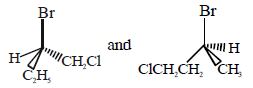
  • A
    enantiomers
  • B
    diastereomers
  • C
    homomenrs
  • constitutional isomer

Answer

Correct option: D.
constitutional isomer
d
$\mathop {\begin{array}{*{20}{c}}
  {\,\,\,Br} \\ 
  | \\ 
  {\mathop C\limits_4 {H_3} - \mathop C\limits_3 {H_2} - \mathop C\limits_2 H - \mathop C\limits_1 {H_2} - Cl} 
\end{array}}\limits_{2 - Bromo - 1 - chlorobu\tan e} $ $\mathop {\begin{array}{*{20}{c}}
  {\,Br\,\,\,\,\,} \\ 
  {|\,\,\,\,\,\,\,} \\ 
  {Cl - \mathop C\limits_1 {H_2} - \mathop C\limits_2 {H_2} - \mathop C\limits_3 H - \mathop C\limits_4 {H_3}} 
\end{array}}\limits_{2 - Bromo - 1 - chlorobu\tan e} $

Need a full question paper?

Generate a complete, print-ready paper with questions like this in minutes — across 16+ boards, with answer keys.

Start Generating Free

Similar questions

The rate of reaction is expressed as

$ + \frac{1}{2}\frac{{d\left[ C \right]}}{{dt}} =  - \frac{1}{3}\frac{{d\left[ D \right]}}{{dt}} =  + \frac{1}{4}\frac{{d\left[ A \right]}}{{dt}} = \frac{{ - d\left[ B \right]}}{{dt}}$

the reaction is

The oxoacid of phosphorus that is easily obtained from a reaction of alkali and white phosphorus and has two $P-H$ bonds, is 
At $25\,^oC$  specific conductivity of a normal solution of $KCl$ is $0.002765\,mho$. The resistance of cell is $ 400\,ohms$. The cell constant is
The amount of $NaOH$ in $gms$ in $250\,c{m^3}$ of a $0.100\,M\,NaOH$ solution would be ........... $gm$
A sugar ' $X$ ' dehydrates very slowly under acidic condition to give furfural which on further reaction with resorcinol gives the coloured product after sometime. Sugar ' $X$ ' is
$\begin{array}{*{20}{c}}
  {C{H_3} - C{H_2} - CH - C{H_3}\xrightarrow[{KOH}]{{Alc.}}\mathop X\limits_{\left( {{\text{major}}} \right)} \,;} \\ 
  {\,\,\,\,\,\,\,\,\,\,\,\,|\,\,\,\,\,\,\,\,\,\,\,\,\,\,\,\,\,\,\,\,\,\,\,\,\,\,\,\,\,\,\,} \\ 
  {\,\,\,\,\,\,\,\,\,\,\,\,\,Br\,\,\,\,\,\,\,\,\,\,\,\,\,\,\,\,\,\,\,\,\,\,\,\,\,\,\,\,\,} 
\end{array}\,$

$\begin{array}{*{20}{c}}
  {C{H_3} - C{H_2} - CH - C{H_3}\xrightarrow[\Delta ]{{EtoNa}}\mathop {{\text{ }}Y}\limits_{\left( {{\text{major}}} \right)} } \\ 
  {{\mkern 1mu} {\mkern 1mu} {\mkern 1mu} {\mkern 1mu} {\mkern 1mu} {\mkern 1mu} {\mkern 1mu} {\mkern 1mu} {\mkern 1mu} {\mkern 1mu} {\mkern 1mu} {\mkern 1mu} |{\mkern 1mu} {\mkern 1mu} {\mkern 1mu} {\mkern 1mu} {\mkern 1mu} {\mkern 1mu} \,\,\,\,\,{\mkern 1mu} \,\,\,\,{\mkern 1mu} {\mkern 1mu} {\mkern 1mu} {\mkern 1mu} {\mkern 1mu} {\mkern 1mu} {\mkern 1mu} {\mkern 1mu} {\mkern 1mu} {\mkern 1mu} {\mkern 1mu} {\mkern 1mu} {\mkern 1mu} {\mkern 1mu} {\mkern 1mu} {\mkern 1mu} {\mkern 1mu} {\mkern 1mu} {\mkern 1mu} {\mkern 1mu} {\mkern 1mu} {\mkern 1mu} {\mkern 1mu} {\mkern 1mu} } \\ 
  {{\mkern 1mu} {\mkern 1mu} {\mkern 1mu} \mathop {{\mkern 1mu} {\mkern 1mu} {\mkern 1mu} {\mkern 1mu} \,\,\,\,\,\,\,NM{e_3}\,\,\,\,\,\,\,{\mkern 1mu} }\limits_{\,\,\,\,\,\,\,\,\,\, \oplus \,\,\,\,\,\,\,\,\,\,\,\,\,\,\,\,\,\,\,\,} {\mkern 1mu} {\mkern 1mu} {\mkern 1mu} {\mkern 1mu} {\mkern 1mu} {\mkern 1mu} {\mkern 1mu} {\mkern 1mu} {\mkern 1mu} {\mkern 1mu} {\mkern 1mu} {\mkern 1mu} {\mkern 1mu} {\mkern 1mu} } 
\end{array}{\mkern 1mu} $

Product $(X)$ and $(Y)$ respectively is

Which of the following compounds will exhibit geometrical isomerism?
The hybridization of orbitals of $N$ atom in $NO_3^-,NO_2^+$ and $NH_4^+$ are respectively :
Solubility product of a salt $AB$ is $1\times10^{-8}$ in a solution in which the concentration of $A^+$ ions is $10^{-3}\, M$. The salt will precipitate when the concentration of $B^-$ ions is kept
When atoms are bombarded with alpha particles, only a few in million suffer deflection, others pass out undeflected. This is because