MCQ
The graph between the energy log $E$ of an electron and its de$-$Broglie wavelength log $\lambda$ will be
  • A

  • B


  • D

Answer

Correct option: C.

c
As we know that, wavelength of a particle

$\lambda=\frac{h}{\sqrt{2 m E}}=\frac{h}{\sqrt{2 m}} \cdot \frac{1}{\sqrt{E}}$

$\Rightarrow \log \lambda=\log \left(\frac{h}{\sqrt{2 m}} \cdot \frac{1}{E}\right)$

$\Rightarrow \log \lambda=\log \frac{h}{\sqrt{2 m}}+\log \frac{1}{E^{1 / 2}}$

$\Rightarrow \log \lambda=\log \left(\frac{h}{\sqrt{2 m}}\right)-\frac{1}{2} \log E$

$\Rightarrow \log \lambda=-\frac{1}{2} \log E+\log \frac{h}{\sqrt{2 m}}$

So, equation of straight line is $y=m x+c$.

This is equation of line with slope $-\frac{1}{2}$.

Need a full question paper?

Generate a complete, print-ready paper with questions like this in minutes — across 16+ boards, with answer keys.

Start Generating Free

Similar questions

A particle has initial velocity of $\left( {\widehat i + \widehat j} \right)\, m/s$ and an acceleration of $\left( {\widehat i + \widehat j} \right)\, m/s^2$. Its speed after $10s$ will be :-
If the speed of light were $2/3$ of its present value, the energy released in a given atomic explosion will be decreased by a fraction
The phase difference between two points separated by $1m$ in a wave of frequency $120 Hz$ is ${90^o}$. The wave velocity is .... $m/s$
A body of mass 2 kg moving with velocity of $\overrightarrow{\mathrm{V}}_{\mathrm{in}}=3 \hat{\mathrm{i}}+4 \hat{\mathrm{j}} \mathrm{ms}^{-1}$ enters into a constant force field of 6N directed along positive z-axis. If the body remains in the field for a period of $\frac{5}{3}$ seconds, then velocity of the body when it emerges from force field is
Water from a pipe is coming at a rate of $100\, litres$ per minute. If the radius of the pipe is $5\, cm$, the Reynolds number for the flow is of the order of : (density of water $= 1000\, kg/m^3$, coefficient of viscosity of water $= 1\, mPa\, s$)
When ${U^{235}}$ is bombarded with one neutron, the fission occurs and the products are three neutrons, $_{36}K{r^{94}}$ and
Assertion : Diamagnetic materials can exhibit magnetism.

Reason : Diamagnetic materials have permanent magnetic dipole moment.
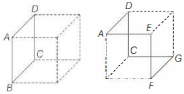
The current in flowing along the path $A B C D$ of a cube (shown in the left figure) produces a magnetic field at the centre of cube of magnitude $B$. Dashed line depicts the non-conducting part of the cube. Consider a cubical shape shown to the right which is identical in size and shape to the left. If the same current now flows in along the path $D A E F G C D$, then the magnitude of magnetic field at the centre will be
The spring extends by $x$ on loading, then energy stored by the spring is :(if $T$ is the tension in spring and $k$ is spring constant)
The quantities of heat required to raise the temperature of two solid copper spheres of radil $r _{1}$ and $r _{2}\left( r _{1}=1.5 r _{2}\right)$ through $1\;K$ are in the ratio