MCQ
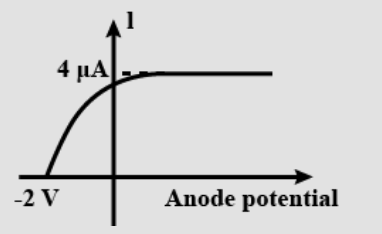
The graph shown below depicts plot of photocurrent versus anode potential for a cathode with 4 eV work function. The energy of the incident photon is:
- A6eV
- B4eV
- C2eV
- D8eV
Explanation:
It is given that
Work function
$\phi$ = 4eV
V = 2V
From Einstein’s relation
hν = $\phi$ + Ek
Where hν is the energy of photons. And Ek is the kinetic energy
hν = (4+2)eV
hν = 6eV
Generate a complete, print-ready paper with questions like this in minutes — across 16+ boards, with answer keys.
Assertion : Dielectric breakdown occurs under the influence of an intense light beam.
Reason : Electromagnetic radiations exert pressure.
|
(a) If both assertion and reason are true and the reason is the correct explanation of the assertion. |
|
(b) If both assertion and reason are true but reason is not the correct explanation of the assertion. |
|
(c) If assertion is true but reason is false. |
|
(d) If the assertion and reason both are false. |
Two plates are 2 cm apart, a potential difference of 10 volt is applied between them, the electric field between the plates is
|
(a) 20 N/C |
(b) 500 N/C |
(c) 5 N/C |
(d) 250 N/C |
Spherical aberration in a lens
|
(a) Is minimum when most of the deviation is at the first surface |
|
(b) Is minimum when most of the deviation is at the second surface |
|
(c) Is minimum when the total deviation is equally distributed over the two surface |
|
(d) Does not depend on the above consideration |
A ray of light is incident at the glass–water interface at an angle i, it emerges finally parallel to the surface of water, then the value of  would be

|
(a) (4/3) sin i |
(b) 1/sin i |
(c) 4/3 |
(d) 1 |
A proton, a deuteron and an α - particle having the same kinetic energy are moving in circular trajectories in a constant magnetic field. If  and
and  denote respectively the radii of the trajectories of these particles, then
|
(a) |
(b) |
(c) |
(d) |
A parallel plate capacitor of capacitance C is connected to a battery and is charged to a potential difference V. Another capacitor of capacitance 2C is connected to another battery and is charged to potential difference 2V. The charging batteries are now disconnected and the capacitors are connected in parallel to each other in such a way that the positive terminal of one is connected to the negative terminal of the other. The final energy of the configuration is
|
(a) Zero |
(b) |
(c) |
(d) |
When an electric dipole  is placed in a uniform electric field
  then at what angle between and the value of torque will be maximum
|
(a) 90° |
(b) 0° |
(c) 180° |
(d) 45° |
An equiconvex lens is cut into two halves along (i) XOX¢ and (ii) YOY¢ as shown in the figure. Let f, f ¢, f ¢¢ be the focal lengths of the complete lens, of each half in case (i), and of each half in case (ii), respectively

Choose the correct statement from the following
|
(a) |
(b) |
(c) |
(d) |


