Question
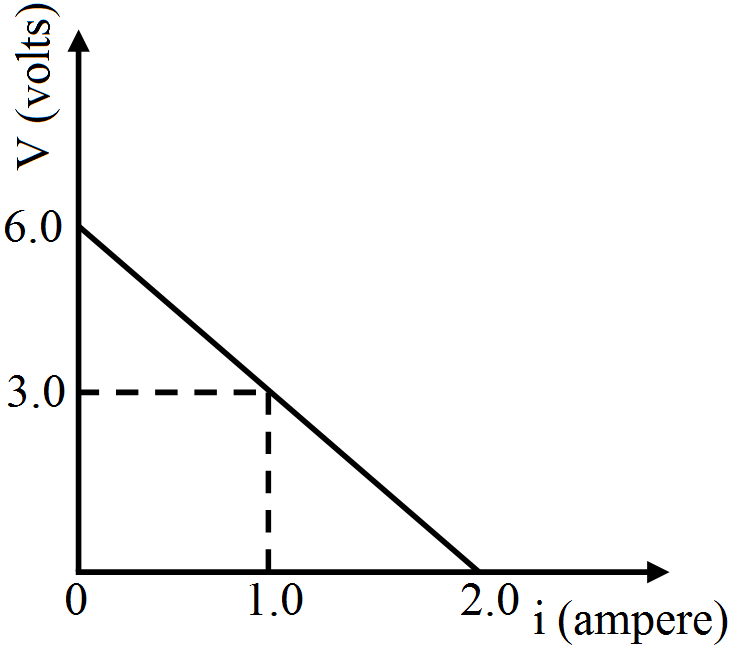
The graph shown here shows the variation of terminal potential difference V, across a combination of three cells in series to a resistor, versus current i:
  1. Calculate the emf of each cell.
  2. For what current i, will the power dissipation of the circuit be maximum?
Answer

Let $\varepsilon$ be emf and r the internal resistance of each cell. The equation of terminal potential difference.
V = $\varepsilon$ eff - i rint becomes,
V = $3\varepsilon$ -i rint …(i)
Where rint is effective (total) internal resistance.
From fig., when i = 0, V = 6.0V
$\therefore$ From (i), $6=3\varepsilon-0\Rightarrow\varepsilon=\frac63=2\text{V}$
i.e., emf of each cell, $\varepsilon=2\text{V}$
Thus, emf of each cell, $\varepsilon=\text{2V}.$

Need a full question paper?

Generate a complete, print-ready paper with questions like this in minutes — across 16+ boards, with answer keys.

Start Generating Free

Similar questions

Double - convex lenses are to be manufactured from a glass of refractive index 1.55, with both faces of the same radius of curvature. What is the radius of curvature required if the focal length is to be 20cm?
The magnetic intensity Hat the centre of a long solenoid carrying a current of 2.0A, is found to be 1500A/m. Find the number of turns per centimetre of the solenoid.
Can an electromagnetic wave be deflected by an electric field or a magnetic field?
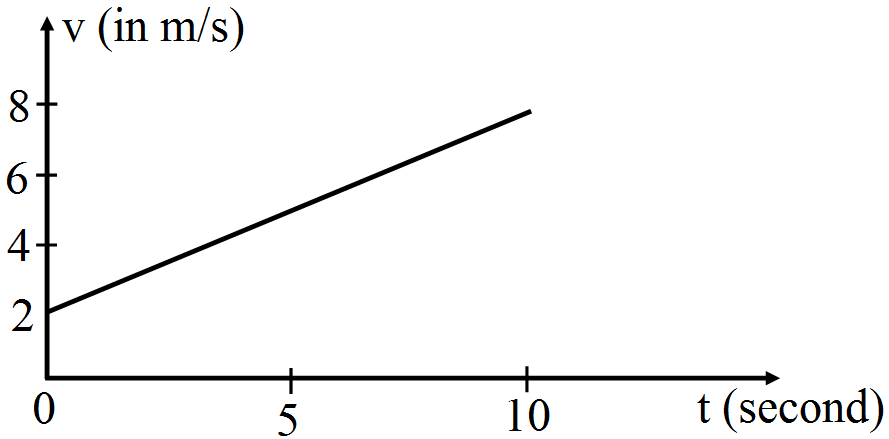
Figure shows the graph of velocity versus time for a particle going along the X-axis. Find:
  1. The acceleration.
  2. The distance travelled in 0 to 10s.
  3. The displacement in 0 to 10s.

A table with smooth horizontal surface is placed in a cabin which moves in a circle of a large radius R (figure In). A smooth pulley of small radius is fastened to the table. Two masses m and 2m placed on the table are connected through a string going over the pulley. Initially the masses are held by a person with the strings along the outward radius and then the system is released from rest (with respect to the cabin). Find the magnitude of the initial acceleration of the masses as seen from the cabin and the tension in the string.

How are em waves produced by oscillating charges? Draw a sketch of linearly polarised em waves propagating in the Z-direction. Indicate the directions of the oscillating electric and magnetic fields.
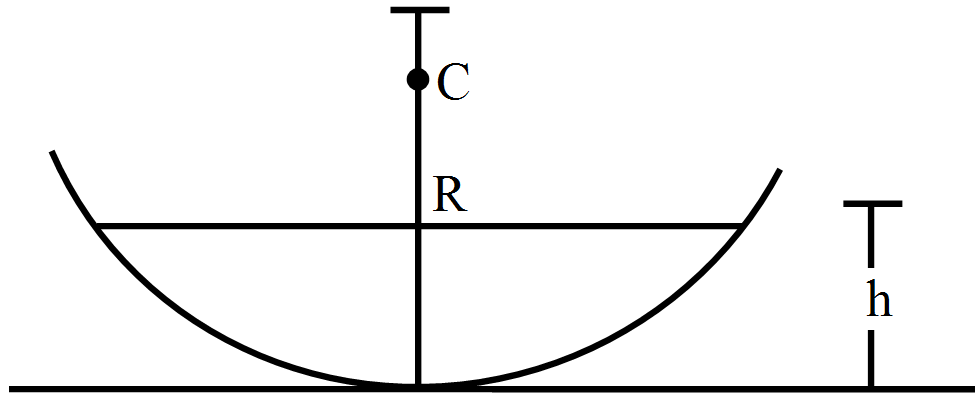
A concave mirror of radius R is kept on a horizontal. Water $\big($refractive index $=\mu\big)$ is poured into it upto a height h. Where should an object be placed so that its image is formed on itself?

  1. Define torque acting on a dipole of dipole moment $\overrightarrow{p}$ placed in a uniform electric field $\overrightarrow{\text{E}}$. Express it in the vector form and point out the direction along which it acts.
  2. What happens if the field is non-uniform?
  3. What would happen if the external field $\overrightarrow{\text{E}}$ is increasing (i) parallel to $\overrightarrow{p}$ and (ii) anti-parallel to $\overrightarrow{p}$?
A horizontal straight wire 10 m long extending from east to west is falling with a speed of $5.0 ms^{-1}$, at right angles to the horizontal component of the earth's magnetic field, $0.30 \times 10^{-4} Wb m ^{-2}$.
a. What is the instantaneous value of the emf induced in the wire?
b. What is the direction of the emf?
c. Which end of the wire is at the higher electrical potential?