MCQ
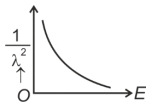
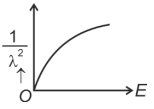
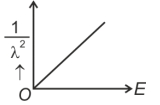
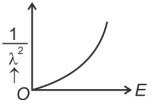
The graph which shows the variation of $\left(\frac{1}{\lambda^2}\right)$ and its kinetic energy, $E$ is (where $\lambda$ is de Broglie wavelength of a free particle):
  • A

  • B


  • D

Answer

Correct option: C.

c
de-Broglie wavelength $\lambda=\frac{h}{P}=\frac{h}{m v}=\frac{h}{\sqrt{2 m E}}$ where $E=\frac{1}{2} m v^2$

Squaring both sides,

$\lambda^2=\frac{h^2}{4 m^2 E}$

$\Rightarrow \frac{1}{\lambda^2}=\text { (constant) } E$

Graph passes through origin with constant slope.

Need a full question paper?

Generate a complete, print-ready paper with questions like this in minutes — across 16+ boards, with answer keys.
Start Generating Free

Similar questions

In an FM system a 7 kHz signal modulates 108 MHz carrier so that frequency deviation is 50 kHz. The carrier swing is
The ionisation potential of hydrogen atom is 13.6 volt. The energy required to remove an electron in the n = 2 state of the hydrogen atom is
A compass needle is free to rotate in a horizontal plane. It’s magnetic moment is $60\ Am^2$ . When it is pointing geographical north, it experiences a torque of $1.2 × 10^{-3}\ Nm$ due to earth’s magnetic field. If earth’s magnetic field in horizontal direction is $40 × 10^{-6}\ T$ , what is declination.....$^o$ at that place ?
If some charge is given to a solid metallic sphere, the field inside remains zero and by Gauss's law all the charge resides on the surface. Now, suppose that Coulomb's force between two charges varies as $1 / r^{3}$. Then, for a charged solid metallic sphere
Core of electromagnets are made of ferromagnetic material which has:
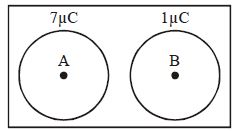
$A$ and $B$ are two identical spheres charge on them is $7\,\mu C$ and $1\,\mu C$ respectively. Now both are connected by a wire. Calculate flow of charge from $A$ to $B$......$\mu C$
Out of the following, which one is not emitted by a natural radioactive substance?
A wire of radius $r$ has resistance $R$. If it is stretched to a radius of $\frac{{3r}}{4}$, its resistance becomes
The electric field at a point on the equatorial plane at a distance $r$ from the centre of a dipole having dipole moment $\overrightarrow{ p }$ is given by, ($r >>$ separation of two charges forming the dipole, $\varepsilon_{0}$ - permittivity of free space)
$\mathrm {F_g}$ and $\mathrm {F_e}$ represents gravitational and electrostatic force respectively between electrons situated at a distance 10 cm. The ratio of $\mathrm{F}_{\mathrm{g}} / \mathrm{F}_{\mathrm{e}}$ is of the order of