Question
The gravitational attraction between electron and proton in a hydrogen atom is weaker than the coulomb attraction by a factor of about 10–40. An alternative way of looking at this fact is to estimate the radius of the first Bohr orbit of a hydrogen atom if the electron and proton were bound by gravitational attraction. You will find the answer interesting.

Answer

Radius of the first Bohr orbit is given by the relation,
$\text{r}_1=\frac{4\pi\in_0\Big(\frac{\text{h}}{2\pi}\Big)^2}{\text{m}_\text{e}\text{e}^2}\ \dots(1)$
Where,
$\in_0$ = Permittivity of free space
h = Planck ' s constant = 6.63 × 10⁻³⁴ Js
me = Mass of an electron = 9.1 × 10⁻³¹ kg
e = Charge of an electron = 1.9 × 10⁻¹⁹ C
mp = Mass of a proton = 1.67 × 10⁻²⁷ kg
r = Distance between the electron and the proton
Coulomb attraction between an electron and a proton is given as:
$\text{F}_\text{C}=\frac{\text{e}^2}{4\pi\in_0\text{r}^2}\ \dots(2)$
Gravitational force of attraction between an electron and a proton is given as:
$\text{F}_\text{G}=\frac{\text{Gm}_\text{p}\text{m}_\text{c}}{\text{r}^2}\ \dots(3)$
Where,
G = Gravitational constant = 6.67 × 10⁻¹¹ N m/ kg2
If the electrostatic (Coulomb) force and the gravitational force between an electron and a proton are equal, then we can write:
$\therefore\ \text{FG}=\text{FC}$
$\frac{\text{Gm}_\text{p}\text{m}_\text{c}}{\text{r}^2}=\frac{\text{e}^2}{4\pi\in_0\text{r}^2}$
$\therefore\ \frac{\text{e}^2}{4\pi\in_0}=\text{Gm}_\text{p}\text{m}_\text{c}\ \dots(4)$
Putting the value of equation (4) in equation (1), we get:
$\text{r}_1=\frac{\Big(\frac{\text{h}}{2\pi}\Big)^2}{\text{Gm}_\text{p}\text{m}_\text{e}^2}$
$=\frac{\Big(\frac{6.63\times10^{-34}}{2\times3.14}\Big)^2}{6.67\times10^{-11}\times1.67\times10^{-27}\times(9.1\times10^{-31})^2}\approx1.21\times10^{29}\text{ m}$
It is known that the universe is 156 billion light years wide or 1.5 × 1027 m wide. Hence, we can conclude that the radius of the first Bohr orbit is much greater than the estimated size of the whole universe.

Need a full question paper?

Generate a complete, print-ready paper with questions like this in minutes — across 16+ boards, with answer keys.

Start Generating Free

Similar questions

For a glass prism $(\mu=\sqrt{3})$ the angle of minimum deviation is equal to the angle of the prism. Find the angle of the prism.
Fe+ ions are accelerated through a potential difference of 500V and are injected normally into a homogeneous magnetic field B of strength 20.0mT. Find the radius of the circular paths followed by the isotopes with mass numbers 57 and 58. Take the mass of an ion = A (1.6 × 10⁻²⁷)kg, where A is the mass number.
A solenoid of length 20cm, area of cross-section 4.0cm2 and having 4000 turns is placed inside another solenoid of 2000 turns having a cross-sectional area 8.0cm2 and length 10cm. Find the mutual inductance between the solenoids.
Consider a box with three terminals on top of it as shown in Fig (a):
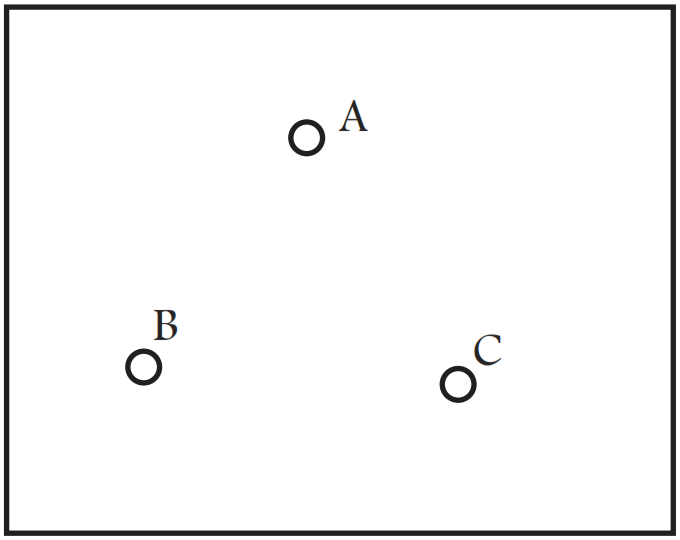
Three components namely, two germanium diodes and one resistor are connected across these three terminals in some arrangement. A student performs an experiment in which any two of these three terminals are connected in the circuit shown in Fig. (b).
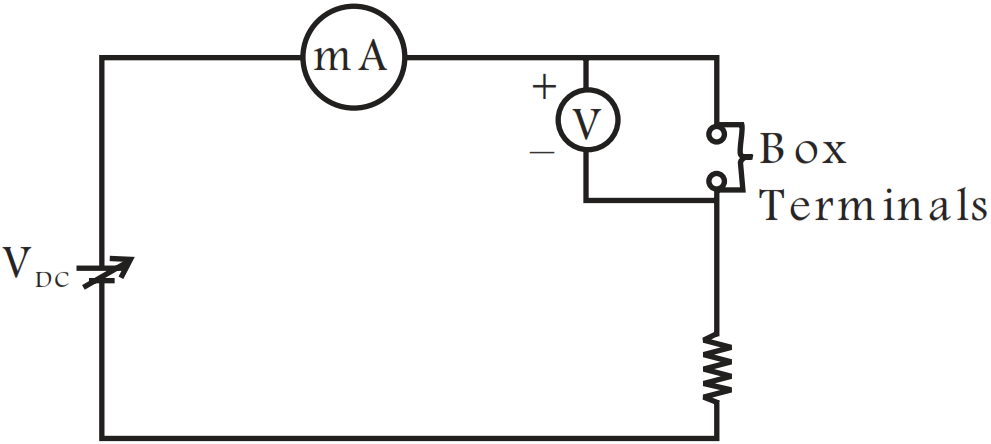
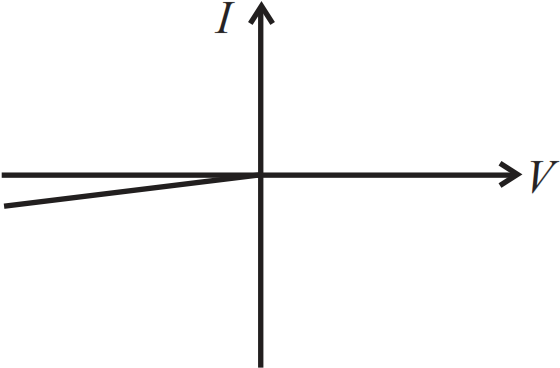
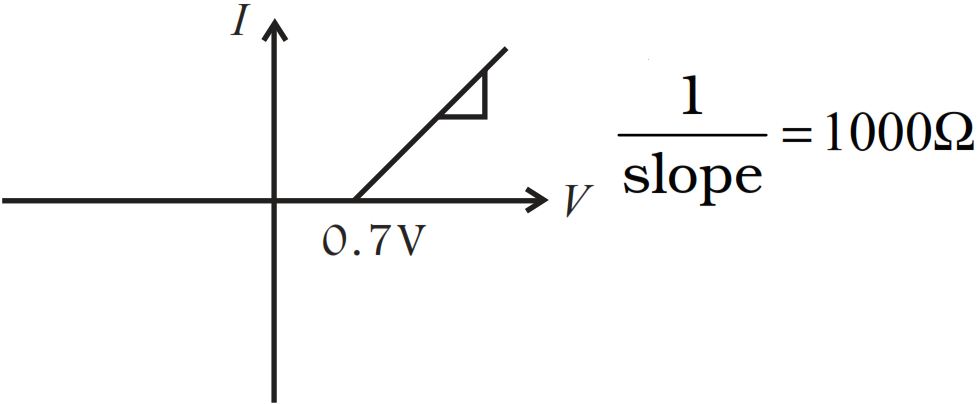
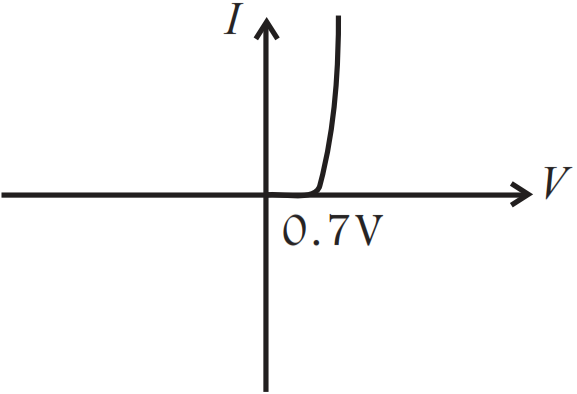
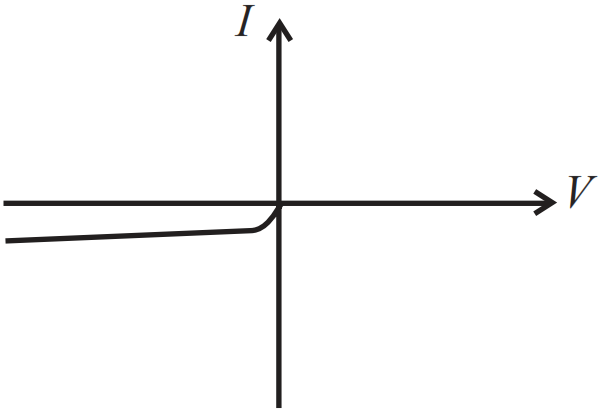
The student obtains graphs of current-voltage characteristics for unknown combination of components between the two terminals connected in the circuit. The graphs are

  1. When A is positive and B is negative,

  1. When A is negative and B is positive,

  1. When B is negative and C is positive,

  1. When B is positive and C is negative,

  1. When A is positive and C is negative,

  1. When A is negative and C is positive,

From these graphs of current - voltage characteristic shown in Fig. (c) to (h), determine the arrangement of components between A, B and C.
A compound microscope consists of an objective lens of focal length 2.0 cm and an eyepiece of focal length 6.25 cm separated by a distance of 15 cm. How far from the objective should an object be placed in order to obtain the final image at (a) the least distance of distinct vision (25 cm), and (b) at infinity? What is the magnifying power of the microscope in each case?
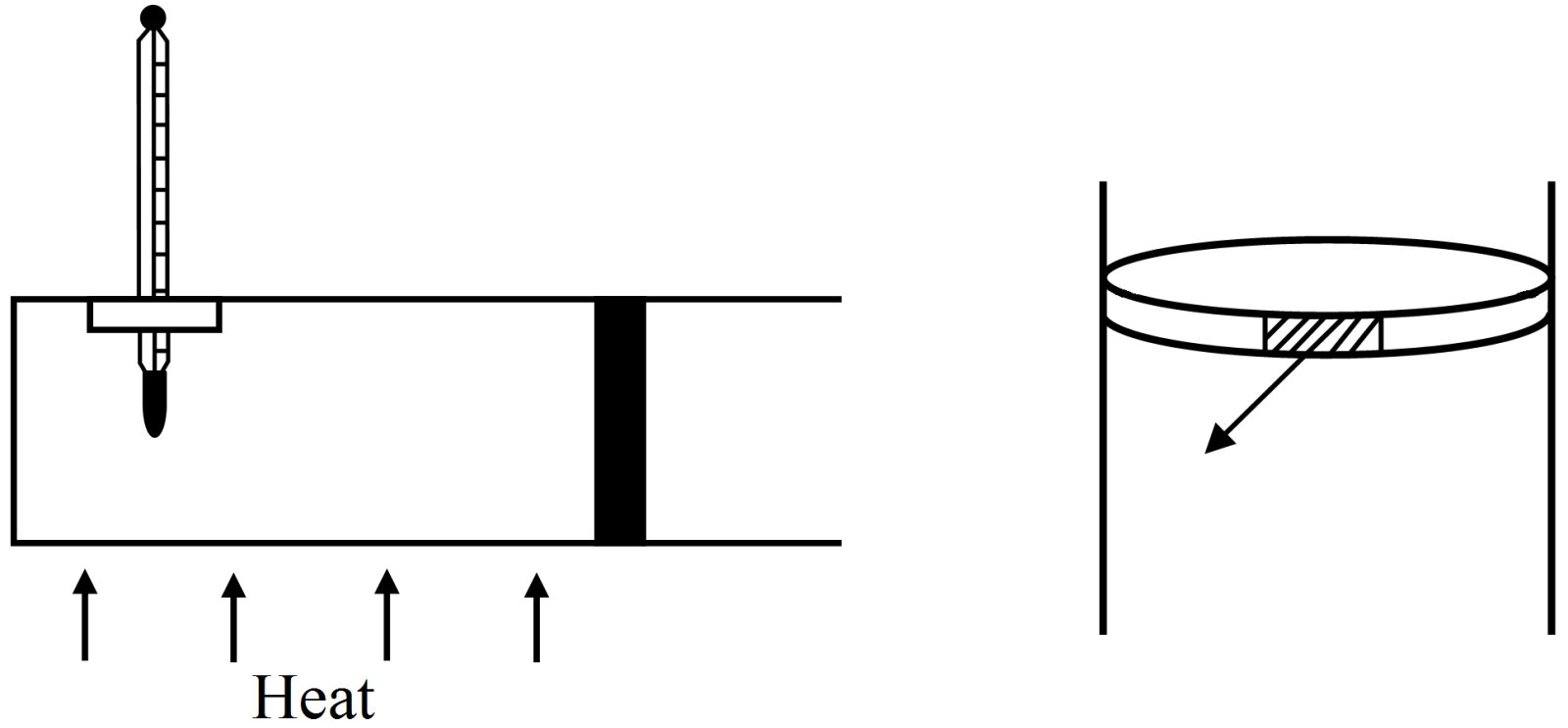
Figure. shows a cylindrical tube of radius 5cm and length 20cm. It is closed by a tight-fitting cork. The friction coefficient between the cork and the tube is 0.20. The tube contains an ideal gas at a pressure of 1 atm and a temperature of 300K. The tube is slowly heated and it is found that the cork pops out when the temperature reaches 600K Let dN denote the magnitude of the normal contact force exerted by a small length dl of the cork along the periphery (see the figure). Assuming that the temperature of the gas is uniform at any instant, calculate $\frac{\text{dN}}{\text{dl}}.$

A circular loop carrying a current i is made of a wire of length L. A uniform magnetic field B exists parallel to the plane of the loop.
  1. Find the torque on the loop.
  2. If the same length of the wire is used to form a square loop, what would be the torque? Which is larger?
When a p-n junction is reverse-biased, the current becomes almost constant at $25\mu\text{A}.$ When it is forwardbiased at 200mV, a current of $75\mu\text{A}$ is obtained. Find the magnitude of diffusion current when the diode is,
  1. Unbiased.
  2. Reverse-biased at 200mV.
  3. Forward-biased at 200mV.
  1. Draw a labelled ray diagram to obtain the real image formed by an astronomical telescope in normal adjustment position. Define its magnifying power.
  2. You are given three lenses of power 0.5 D, 4 D and 10 D to design a telescope:
  1. Which lenses should he used as objective and eyepiece? Justify your answer.
  2. Why is the aperture of the objective preferred to be large?
A battery of emf 100V and a resistor of resistance $10\text{k}\Omega$ are joined in series. This system is used as a source to supply current to an external resistance R. If R is not greater than $100\Omega,$ the current through it is constant up to two significant digits. Find its value. This is the basic principle of a constant-current source.