MCQ
The gravitational force ${F_g}$ between two objects does not depend on
  • Sum of the masses
  • B
    Product of the masses
  • C
    Gravitational constant
  • D
    Distance between the masses

Answer

Correct option: A.
Sum of the masses
a
(a) $F_Gravitational$ $=\mathrm{F}=\left[\left(\mathrm{G} \cdot \mathrm{m}_{1} \cdot \mathrm{m}_{2}\right) / \mathrm{D}_{2}\right]$

$\mathrm{m}_{1}, \mathrm{m}_{2}$ are masses of bodies and $\mathrm{D}$ is distance between them.

$\mathrm{G}=$ Gravitational constant.

Need a full question paper?

Generate a complete, print-ready paper with questions like this in minutes — across 16+ boards, with answer keys.
Start Generating Free

Similar questions

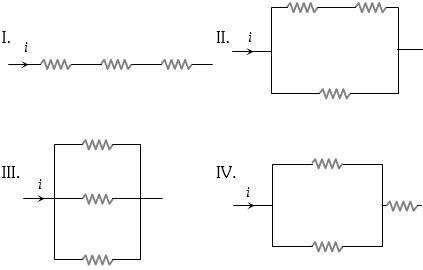
The three resistance of equal value are arranged in the different combinations shown below. Arrange them in increasing order of power dissipation.
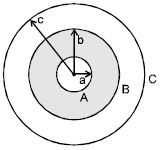
$A$ and $C$ are concentric conducting spherical shells of radius $a$ and $c$ respectively. $A$ is surrounded by a concentric dielectric of inner radius $a$, outer radius $b$ and dielectric constant $k$. If sphere $A$ is given a charge $Q$, the potential at the outer surface of the dielectric is.
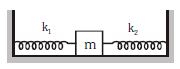
A block of mass $m$ is attached to two springs of spring constants $k_1$ and $k_2$ as shown in figure. The block is displaced by $x$ towards right and released. The velocity of the block when it is at $x/2$ will be
The nature of sun’s spectrum is
If radius of the sphere is $(5.3 \pm 0.1)\;cm$. Then percentage error in its volume will be
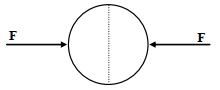
A uniformly charged thin spherical shell of radius $\mathrm{R}$ carries uniform surface charge density of $\sigma$ per unit area. It is made of two hemispherical shells, held together by pressing them with force $\mathrm{F}$ (see figure). $\mathrm{F}$ is proportional to
A nucleus at rest splits into two nuclear parts having same density and the radii in the ratio $1 : 2$ . Their velocities are in ratio ———
A long solenoid has $200$ $turns$ per $cm$ and carries a current $i$. The magnetic field at its centre is $6.28 \times  10^{-2} $ $\frac{{Wb}}{{{m^2}}}$ Another long solenoid has $100$ $turns$ per $cm$ and it carries a current  $\frac{I}{3}\;$ . The value of the magnetic field at its centre is
The factor not needed to calculate heat lost or gained when there is no change of state is
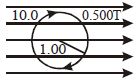
A single circular loop of radius $1.00\, m$ carries a current of $10.0\, mA$. It is placed in $a$ uniform magnetic field of magnitude $0.500\, T$ that is directed parallel to the plane of the loop as suggested in the figure. The magnitude of the torque exerted on the loop by the magnetic field is.