MCQ
The gravitational force ${F_g}$ between two objects does not depend on
  • Sum of the masses
  • B
    Product of the masses
  • C
    Gravitational constant
  • D
    Distance between the masses

Answer

Correct option: A.
Sum of the masses
a
(a) $F_Gravitational$ $=\mathrm{F}=\left[\left(\mathrm{G} \cdot \mathrm{m}_{1} \cdot \mathrm{m}_{2}\right) / \mathrm{D}_{2}\right]$

$\mathrm{m}_{1}, \mathrm{m}_{2}$ are masses of bodies and $\mathrm{D}$ is distance between them.

$\mathrm{G}=$ Gravitational constant.

Need a full question paper?

Generate a complete, print-ready paper with questions like this in minutes — across 16+ boards, with answer keys.
Start Generating Free

Similar questions

Dimensions of kinetic energy are
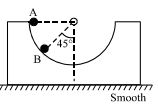
Aball of mass $m$ is released from Ainside $a$ smooth wedge of mass $m$ as shown in the figure. What is the speed of the wedge when the ball reaches point $B$ ?
The period of oscillation of a simple pendulum is $T=2\pi \sqrt {\frac{l}{g}} $. Measured value of $L$ is $20.0\; cm$ known to $1\; mm$ accuracy and time for $100$ oscillations of the pendulum is found to be $90\ s$ using a wrist watch of $1\; s$ resolution. The accuracy in the determination of $g$ is   ........ $\%$
The weight of an astronaut, in an artificial satellite revolving around the earth, is
If in an experiment for determination of velocity of sound by resonance tube method using a tuning fork of $512 Hz$, first resonance was observed at $30.7 cm$ and second was obtained at $63.2 cm$, then maximum possible error in velocity of sound is .....$cm/sec$ (consider actual speed of sound in air is $332 m/s$)
A device used to measure very high temperature is
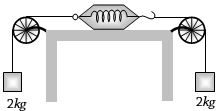
As shown in the figure, two equal masses each of $2\, kg$ are suspended from a spring balance. The reading of the spring balance will be ......... $kg$
An arrow is shot into air. Its range is $200\,m$ and its time of flight is $5\,s$. If $g=10\,m / s ^2$, then horizontal component of velocity and the maximum height will be respectively
An ideal gas is filled in a vessel, then
A particle of mass m is attached to a spring (of spring constant k) and has a natural angular frequency ${\omega _0}$ - An external force $F (t)$ proportional to $\cos \omega \,t((\omega \ne {\omega _0})$ is applied to the oscillator. The time displacement of the oscillator will be proportional to