Question
The greatest integer function defined by f(x) = [x], 0 < x < 2 is not differentiable at x = _________.

Answer

The greatest integer function defined by f(x) = [x], 0 < x < 2 is not differentiable at x = 1.Solution:
The given function f is f(x) = [x], 0 < x < 2
It is known that a function f is differentiable at a point x = c in its domain if both
$\lim\limits_{\text{h}\rightarrow0^-}\frac{\text{f}\text{(c+h)}-\text{f(c)}}{\text{h}}$ and $\lim\limits_{\text{h}\rightarrow0^+}\frac{\text{f}\text{(c+h)}-\text{f(c)}}{\text{h}}$ are finite and equal.
To check the differentiability of the given function at x = 1, consider the left hand limit of f at x = 1
$\lim\limits_{\text{h}\rightarrow0^-}\frac{\text{f}(1+\text{h})-\text{f(1)}}{\text{h}}=\lim\limits_{\text{h}\rightarrow0^-}\frac{[1+\text{h}]-[1]}{\text{h}}$
$\lim\limits_{\text{h}\rightarrow0^-}\frac{0-1}{\text{h}}=\lim\limits_{\text{h}\rightarrow0^-}\frac{-1}{\text{h}}=\infty$
Consider the right hand limit of f at x = 1
$\lim\limits_{\text{h}\rightarrow0^+}\frac{\text{f}(1+\text{h})-\text{f}(1)}{\text{h}}=\lim\limits_{\text{h}\rightarrow0^+}\frac{[1+\text{h}]-[1]}{\text{h}}$
$\lim\limits_{\text{h}\rightarrow0^+}\frac{1-1}{\text{h}}=\lim\limits_{\text{h}\rightarrow0^+}0=0$
Since the left and right hand limits of f at x = 1 are not equal, f is not differentiable at x = 1

Need a full question paper?

Generate a complete, print-ready paper with questions like this in minutes — across 16+ boards, with answer keys.
Start Generating Free

Similar questions

I.F. of the differential equation $x \frac{d y}{d x}+2 y=x^2$ will be _______________ .
Fill in the blank. In applying one or more row operations while finding $A^{-1}$ by elementary row operations, we obtain all zeros in one or more, then $A^{-1}........$
If A has 3 order invertible matrix and $| A |=3$, then $|\operatorname{adj} A |=$ ________ .
If $A =\left[\begin{array}{l}2 \\ 5\end{array}\right], B =[7,8]$, then the value of $BA$ is $........$
Fill in the blanks:
The least value of the function $\text{f(x)}=\text{ax}+\frac{\text{b}}{\text{a}}(\text{a}>0,\text{b}>0,\text{x}>0)$ is ______.
If Dc's of a line are k, k, k, then k will be ___________ .
Fill in the blanks.
The values of k for which $|\text{k}\vec{\text{a}}|<|\vec{\text{a}}|$ and $\text{k}\vec{\text{a}}=\frac{1}{2}\vec{{\text{a}}}$ is a parallel to $\vec{\text{a}}$ holds true are _________.
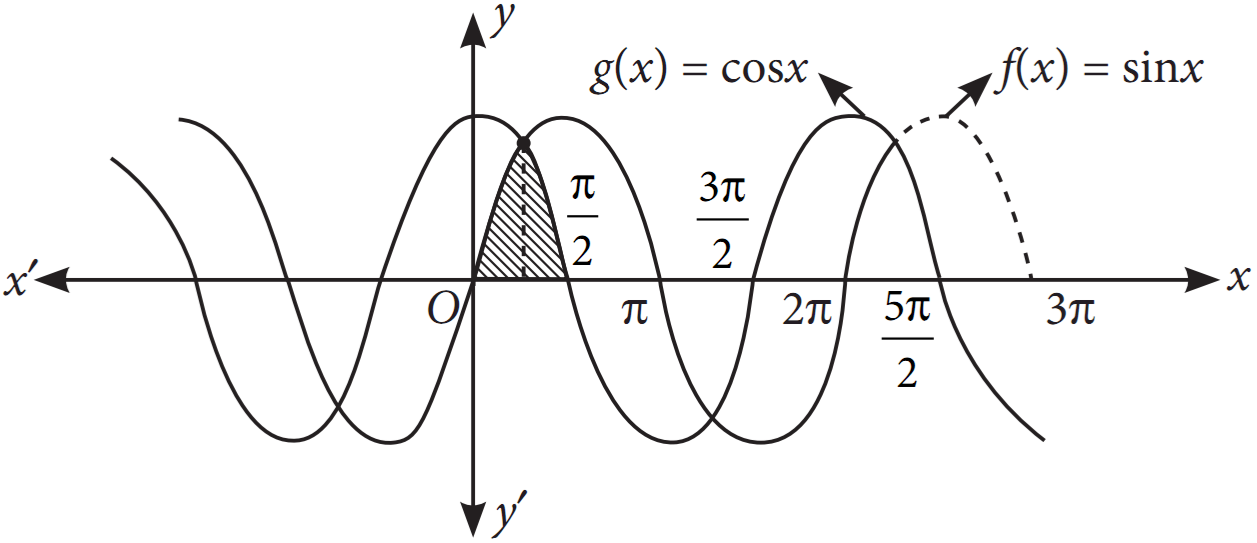
Graphs of two function $\text{f}(\text{x})=\text{sin}\text{ x}$ and $\text{(g)}\text{x}=\text{cos}\text{ x}$ is given below:

Based on the above information, answer the following questions.
  1. In $(0, \pi)$, the curves $\text{f}(\text{x})=\text{sin}\text{ x}$ and $\text{g}\text{ (x)}=\text{cos}\text{ x}$ at $\text{x}=$ 
    1. $\frac{\pi}{2}$
    2. $\frac{\pi}{3}$
    3. $\frac{\pi}{4}$
    4. ${\pi}$
  2. Value of $\int\limits_{0}^{\frac{\pi}{4}}\text{sin}\text{ x}\text{ dx}$ is.
    1. $1-\frac{1}{\sqrt{2}}$
    2. $1+\frac{1}{\sqrt{2}}$
    3. $2-\frac{1}{\sqrt{2}}$
    4. $2+\frac{1}{\sqrt{2}}$
  1. Value of $\int\limits_\frac{\pi}{4}^{\frac{\pi}{2}}\text{cos}\text{ x}\text{ dx}$ is.
    1. $1+\frac{1}{\sqrt{2}}$
    2. $1-\frac{1}{\sqrt{2}}$
    3. $2-\sqrt{2}$
    4. $2+\sqrt{2}$
  2. Value of $\int\limits_{0}^{\pi}\text{sin}\text{ x}\text{ dx}$ is.
  1. 0
  2. 1
  3. 2
  4. -2
  1. Value of $\int\limits_{0}^\frac{\pi}{2}\text{sin}\text{ x}\text{ dx}$ is.
  1. 0
  2. 1
  3. 3
  4. 4
If $y=\tan x^2$ then $\frac{d y}{d x}=$……..
The range of principal value branch of $y=\sec ^{-1} x$ is _________