Question
The greatest integer function defined by f(x) = [x], 0 < x < 2 is not differentiable at x = _________.

Answer

The greatest integer function defined by f(x) = [x], 0 < x < 2 is not differentiable at x = 1.Solution:
The given function f is f(x) = [x], 0 < x < 2
It is known that a function f is differentiable at a point x = c in its domain if both
$\lim\limits_{\text{h}\rightarrow0^-}\frac{\text{f}\text{(c+h)}-\text{f(c)}}{\text{h}}$ and $\lim\limits_{\text{h}\rightarrow0^+}\frac{\text{f}\text{(c+h)}-\text{f(c)}}{\text{h}}$ are finite and equal.
To check the differentiability of the given function at x = 1, consider the left hand limit of f at x = 1
$\lim\limits_{\text{h}\rightarrow0^-}\frac{\text{f}(1+\text{h})-\text{f(1)}}{\text{h}}=\lim\limits_{\text{h}\rightarrow0^-}\frac{[1+\text{h}]-[1]}{\text{h}}$
$\lim\limits_{\text{h}\rightarrow0^-}\frac{0-1}{\text{h}}=\lim\limits_{\text{h}\rightarrow0^-}\frac{-1}{\text{h}}=\infty$
Consider the right hand limit of f at x = 1
$\lim\limits_{\text{h}\rightarrow0^+}\frac{\text{f}(1+\text{h})-\text{f}(1)}{\text{h}}=\lim\limits_{\text{h}\rightarrow0^+}\frac{[1+\text{h}]-[1]}{\text{h}}$
$\lim\limits_{\text{h}\rightarrow0^+}\frac{1-1}{\text{h}}=\lim\limits_{\text{h}\rightarrow0^+}0=0$
Since the left and right hand limits of f at x = 1 are not equal, f is not differentiable at x = 1

Need a full question paper?

Generate a complete, print-ready paper with questions like this in minutes — across 16+ boards, with answer keys.
Start Generating Free

Similar questions

Fill in the blanks.
In a LPP, the linear inequalities or restrictions on the variables are called _________.
If A and B are two $3 \times 3$ order square matrix and $|A|=5,|B|=5$ then $|3 A B|=$ ________ .
The radius of a circle in increasing at the rate of 0.7 cm/sec, then rate of change in circumference of circle will be ___________ .
Fill in the blanks.
A corner point of a feasible region is a point in the region which is the _________ of two boundary lines.
Dfferentiation of $\cos (\sqrt{x})$ w.r.t. $x$ is ________ .
Fill in the blank.
The value of $\cos^{-1}\Big(\cos\frac{14\pi}{3}\Big)$ is __________.
Fill in the blank.
If A and B are symmetric matrices of same order, then AB is symmetric if and only if _________.
If any element of A is not related to any element of A. This relation R is defined on A is know as _________
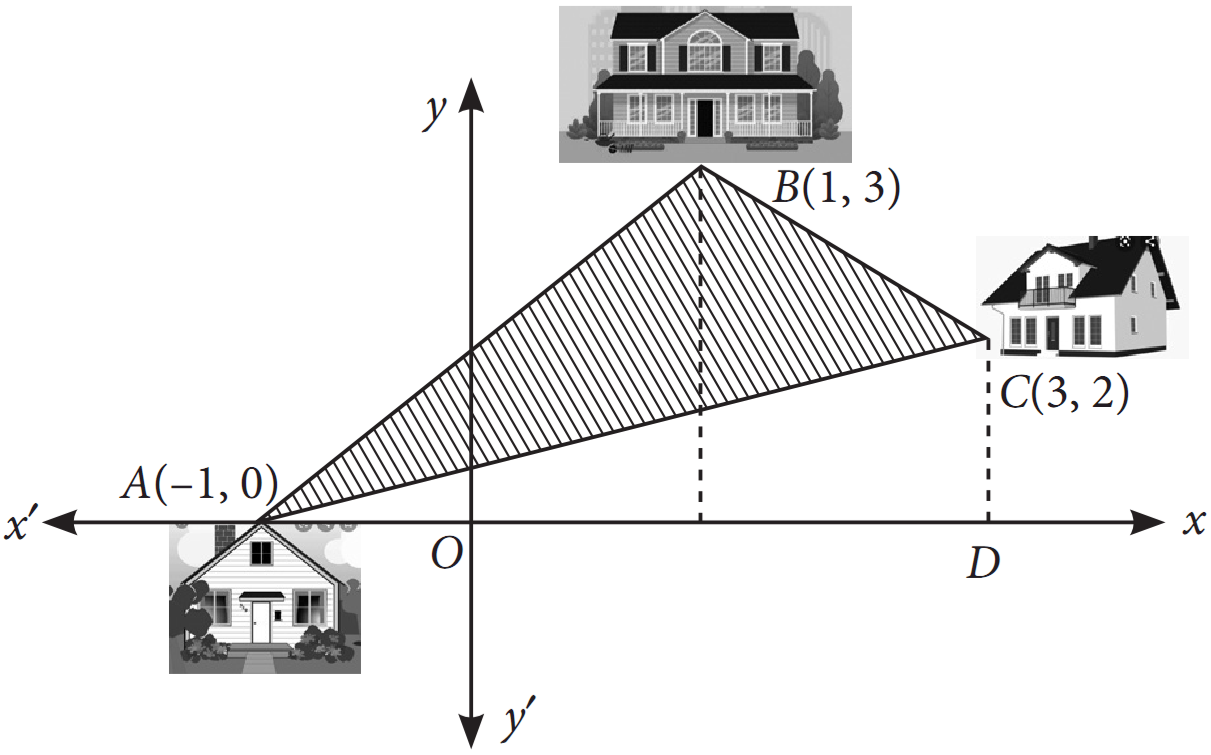
Location of three houses of a society is represented by the points A(-1, 0), B(1, 3) and C(3, 2) as shown in figure.

Based on the above information, answer the following questions
  1. Equation of line AB is.
    1. $\text{y}=\frac{3}{2}(\text{x}+1)$
    2. $\text{y}=\frac{3}{2}(\text{x}-1)$
    3. $\text{y}=\frac{1}{2}(\text{x}+1)$
    4. $\text{y}=\frac{1}{2}(\text{x}-1)$
  2. Equation of line BC is.
    1. $\text{y}=\frac{1}{2}\text{x}-\frac{7}{2}$
    2. $\text{y}=\frac{3}{2}\text{x}-\frac{7}{2}$
    3. $\text{y}=\frac{-1}{2}\text{x}+\frac{7}{2}$
    4. $\text{y}=\frac{3}{2}\text{x}+\frac{7}{2}$
  3. Area of region ABCD is.
  1. 2 sq. units
  2. 4 sq. units
  3. 6 sq. units
  4. 8 sq. units
  1. Area of $\triangle\text{ADC}$ is,
  1. 4 sq. units
  2. 8 sq. units
  3. 16 sq. units
  4. 32 sq. units
  1. Area of $\triangle\text{ABC}$ is.
  1. 3 sq. units
  2. 4 sq. units
  3. 5 sq. units
  4. 6 sq. units
If $y=e^{x^2}$, then at $x=4$ the value of $\frac{d y}{d x}$ will be.______