MCQ
The greatest integer which divides the number ${101^{100}} - 1$, is
  • A
    $100$
  • B
    $1000$
  • $10000$
  • D
    $100000$

Answer

Correct option: C.
$10000$
c
(c) ${(1 + 100)^{100}} = 1 + 100.100 + \frac{{100.99}}{{1.2}}.{(100)^2} + \frac{{100.99.98}}{{1.2.3}}{(100)^3} + ....$

${(101)^{100}} - 1 = 100.100\left[ {1 + \frac{{100.99}}{{1.2}} + \frac{{100.99.98}}{{1.2.3}}.100 + ....} \right]$

From above it is clear that,

${(101)^{100}} - 1$ is divisible by $(100)^2$ $= 10000$

Need a full question paper?

Generate a complete, print-ready paper with questions like this in minutes — across 16+ boards, with answer keys.

Start Generating Free

Similar questions

Let $P, Q $ and $R$ are three co-normal points on the parabola $y^2 = 4ax.$  Then the correct statement$(s)$  is/are
If $\operatorname{gcd}( m , n )=1$ and $1^2-2^2+3^2-4^2+\ldots \ldots$ $+(2021)^2-(2022)^2+(2023)^2=1012 m ^2 n$, then $m ^2- n ^2$ is equal to
The points of trisection of the line segment joining the points $(3, -2)$ and $(-3, -4)$ are
Let $f(x)=a x^2+b x+c$, where $a, b, c$ are integers, Suppose $f(1)=0,40 < f(6) < 50,60 < f(7) < 70$ and $1000 t < f(50) < 1000(t+1)$ for some integer $t$. Then, the value of $t$ is
If $\text{OP}$ makes $4$ revolutions in on second the angular velocity in radians per seconds is:
Let $G$ be a circle of radius $R>0$. Let $G_1, G_2, \ldots, G_n$ be $n$ circles of equal radius $r>0$. Suppose each of the $n$ circles $G_1, G_2, \ldots, G_n$ touches the circle $G$ externally. Also, for $i=1,2, \ldots, n-1$, the circle $G_i$ touches $G _{ i +1}$ extemally, and $G _{ n }$ touches $G _1$ externally. Then, which of the following statements is/are $TRUE$ ?

$(A)$ If $n =4$, then $(\sqrt{2}-1) r < R$

$(B)$ If $n =5$, then $r < R$

$(C)$ If $n =8$, then $(\sqrt{2}-1) r < R$

$(D)$ If $n =12$, then $\sqrt{2}(\sqrt{3}+1) r > R$
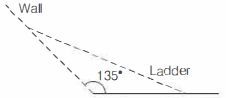
A wall is inclined to the floor at an angle of $135^{\circ}$. A ladder of length $l$ is resting on the wall. As the ladder slides down, its mid-point traces an arc of an ellipse. Then, the area of the ellipse is
If $\left(\frac{3^{6}}{4^{4}}\right) \mathrm{k}$ is the term, independent of $\mathrm{x}$, in the binomial expansion of $\left(\frac{\mathrm{x}}{4}-\frac{12}{\mathrm{x}^{2}}\right)^{12}$, then $\mathrm{k}$ is equal to ...... .
The last digit of $(3^P + 2)$ is :  where $P = 3^{4n}$ and $n \in N$
The chance of an event happening is the square of the chance of a second event but the odds against the first are the cube of the odds against the second. The chances of the events are