MCQ
The ${H^ + }$ ion concentration is $1.0 \times {10^{ - 6}}$ mole/litre in a solution. Its $pH $ value will be
  • A
    $12$
  • $6$
  • C
    $18$
  • D
    $24$

Answer

Correct option: B.
$6$
(b) $[{H^ + }] = 1.00 \times {10^{ - 6}}$ mole/litre

$pH = - \,\log \,\,[1.00 \times {10^{ - 6}}]$;  $pH = 6.$

Need a full question paper?

Generate a complete, print-ready paper with questions like this in minutes — across 16+ boards, with answer keys.

Start Generating Free

Similar questions

Ortho-Nitrophenol is less soluble in water than $p-$ and $m-$­Nitrophenols because :
Molality $(m)$ of $3 \ M$ aqueous solution of $NaCl$ is: $($Given $:$ Density of solution $= 1.25 \ g \ mL^{–1},$ Molar mass in $g \ mol^{–1} : Na-23, Cl-35.5)$
The $C-H$ bond distance is longest in
Upon heating $KClO_3$ in the presence of catalytic amount of $MnO_2$, a gas $W$ is formed. Excess amount of $W$ reacts with white phosphorus to give $X$. The reaction of $X$ with $HNO_3$ gives $Y$ and $Z$.

($1$)  $W$ and $\mathbf{X}$ are, respectively

$[A]$ $O_3$ and $P_4 O_6$   $[B]$ $O_2$ and $P_4 O_6$   $[C]$ $O_2$ and $P_4 O_{10}$    $[D]$ $O_3$ and $P_4 O_{10}$

($2$) $Y$ and $Z$ are, respectively

$[A]$ $N_2 O_3$ and $\mathrm{H}_3 \mathrm{PO}_4$

$[B]$ $N_2 O_5$ and $\mathrm{HPO}_3$

$[C]$ $N_2 O_4$ and $HPO_3$

$[D]$ $N_2 O_4$ and $H_3 PO_3$

Give the answer of quetion ($1$) and ($2$)

Which of the following reaction is called as ‘Bouveault-Blanc reduction’
Which of the following series of transitions in the spectrum of hydrogen atom falls in visible region ?
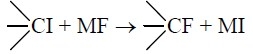
In the replacement reaction

The reaction will be most favourable if $M$ happens to be
The ratio of amounts of ${H_2}S$ needed to precipitate all the metal ions from $100\, ml$ of $1\, M$ $AgN{O_3}$ and $100\, ml$ of $1 \,M$ $CuS{O_4}$ will be
$\left( P \right)\,\xrightarrow{\Delta }\,\left( Q \right)$ metallic solid $ + \left( R \right) \uparrow \, + \,\left( S \right) \uparrow $

$\left( X \right)\,\xrightarrow{\Delta }\,\left( Y \right)$ amphoteric $ + \left( R \right) \uparrow \, + \,\left( S \right) \uparrow $

$P$ and $X$ are respectively

The addition of $HI$ in the presence of peroxide catalyst does not follow anti-Markovnikov's rule because