MCQ
The $\text{HCF}$ of two consecutive numbers is :
  • A
    $2$
  • $1$
  • C
    $0$
  • D
    $3$

Answer

Correct option: B.
$1$
The $\text{HCF}$ of two consecutive numbers is always $1.$
$ ($e.g. $\text{HCF}$ of $24, 25$ is $1).$

Need a full question paper?

Generate a complete, print-ready paper with questions like this in minutes — across 16+ boards, with answer keys.
Start Generating Free

Similar questions

The line segment joining the points $P (-3,2)$ and $Q (5,7)$ is divided by the $y -$axis in the ratio
If a chord of a circle of radius $28\ cm$ makes an angle of $90^\circ$ at the centre, then the area of the major segment is :
The $\text{HCF}$ of $95$ and $152$, is :
The string of a kite is $100m$ long and it makes an angle of $60^\circ$ with the horizontal. If these is no slack in the string, the height of the kite from the ground is :
If two tangents inclined at an angle 60° are drawn to a circle of radius 3cm, then length of each tangent is equal to:
Directions : In the following questions, the Assertions $(A)$ and Reason $(s)\ (R)$ have been put forward. Read both the statements carefully and choose the correct alternative from the following:
Assertion : Sum of first hundred even natural numbers divisible by $5$ is $500.$
Reason : Sum of first $n-$ terms of an $A.P$. is given by $\text{s}_\text{n}=\frac{\text{n}}{2}[\text{a+}\ell] \text{ where }\ell =$ last term.
One side of a rhombus is $20\ cm$ long and one of its diagonals measure $24\ cm.$ The area of the rhombus is :
If $\alpha,\beta$ are the zeros of the polynomial $p(x)=4 x^2+3 x+7$, then $\frac{1}{\alpha}+\frac{1}{\beta}$ is equal to :
The value $(s)$ of $k$ for which the quadratic equation $2x^2+ kx + 2 = 0$ has equal roots, is :
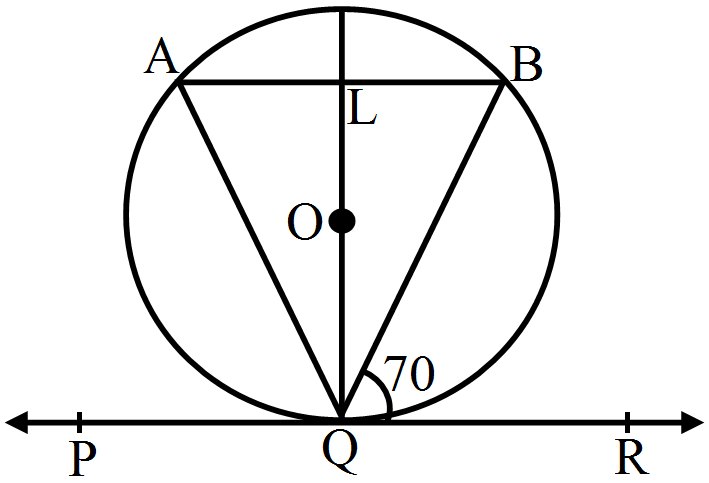
In the given figure, PQR is a tangent to the circle at Q, whose centre is O and AB is a chord parallel to PR, such that$ \angle\text{BQR} = 70^\circ.$ Then, $\angle\text{AQB}=?$