MCQ
The heat absorbed by a system in going through the given cyclic process is:
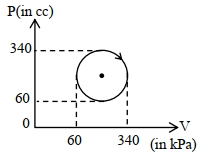
  • $61.6 \mathrm{~J}$
  • B
     $431.2 \mathrm{~J}$
  • C
    $616 \mathrm{~J}$
  • D
    $19.6 \mathrm{~J}$

Answer

Correct option: A.
$61.6 \mathrm{~J}$
a
$\Delta \mathrm{U}=0 \text { (Cyclic process) }$

$\Delta \mathrm{Q}=\mathrm{W}=\text { area of } \mathrm{P}-\mathrm{V} \text { curve. }$

$=\pi \times\left(140 \times 10^3 \mathrm{~Pa}\right) \times\left(140 \times 10^{-6} \mathrm{~m}^3\right)$

$\Delta \mathrm{Q}=61.6 \mathrm{~J}$

Need a full question paper?

Generate a complete, print-ready paper with questions like this in minutes — across 16+ boards, with answer keys.

Start Generating Free

Similar questions

A body of mass 2kg travels according to the law x(t) = pt + qt2 rt3 where p = 3m s-1, q = 4m s-2 and r = 5m s-3. The force acting on the body at t = 2 seconds is.
Two solids $A$  and $ B$ float in water. It is observed that $A$  floats with half its volume immersed and $B$  floats with $2/3$  of its volume immersed. Compare the densities of $A$ and $B$
The initial speed of a projectile fired from ground is $u$. At the highest point during its motion, the speed of projectile is $\frac{\sqrt{3}}{2} u$. The time of flight of the projectile is:
A machine gun is mounted on a $2000 \,kg$ car on a horizontal frictionless surface. At some instant the gun fires bullets of mass $10\, gm$ with a velocity of $500 \,m/sec$ with respect to the car. The number of bullets fired per second is ten, the acceleration of the car will be .....$\,m/{\sec ^2}$
A bomb at rest explodes into three fragments $X, Y$ and $Z$. Each one of them has the same mass. Which of the following correctly describes the motion of the fragments?
A drop of liquid of diameter $2.8\, mm$ breaks up into $125$ identical drops. The change in energy is nearly ......... $ergs$ (Surface tension $= 75\, dyne/cm$)
A projectile is thrown from a point $O$ on the ground at an angle $45^{\circ}$ from the vertical and with a speed $5 \sqrt{2} m / s$. The projectile at the highest point of its trajectory splits into two equal parts. One part falls vertically down to the ground, $0.5 s$ after the splitting. The other part, $t$ seconds after the splitting, falls to the ground at a distance $x$ meters from the point $O$. The acceleration due to gravity $g =10 m / s ^2$.

($1$) The value of $t$ is. . . . . . 

($2$) The value of $x$ is. . . . . 

Give the answer or qution ($1$) and ($2$)
What is the maximum acceleration of the particle doing the $SHM$ $y = 2\sin \left[ {\frac{{\pi t}}{2} + \phi } \right]$ where $2$ is in $cm$
If the wave equation $y = 0.08\sin \frac{{2\pi }}{\lambda }(200t - x)$ then the velocity of the wave will be
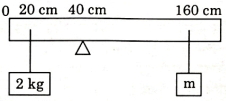
A uniform rod of length $200 \,\mathrm{~cm}$ and mass $500 \,\mathrm{~g}$ is balanced on a wedge placed at $40\,cm$ mark. A mass of $2\, \mathrm{~kg}$ is suspended from the rod at $20\, \mathrm{~cm}$ and another unknown mass $'m'$ is suspended from the rod at $160\, \mathrm{~cm}$ mark as shown in the figure. Find the value of $'m'$ such that the rod is in equilibrium. $\left(\mathrm{g}=10 \,\mathrm{~m} / \mathrm{s}^{2}\right)$