MCQ
The height at which the acceleration due to gravity becomes $\frac{g}{9}$ (where $g$ = the acceleration due to gravity on the surface of the earth) in terms of $R$, the radius of the earth, is
  • $2R$
  • B
    $\frac{R}{{\sqrt 2 }}$
  • C
    $\;\frac{R}{2}$
  • D
    $\;\sqrt {2R} $

Answer

Correct option: A.
$2R$
a
We know that $\frac{{g'}}{g} = \frac{{{R^2}}}{{{{\left( {R + h} \right)}^2}}}$

$\therefore \frac{{g/9}}{g} = {\left[ {\frac{R}{{R + h}}} \right]^2}\,\,\,\therefore h = 2R$

Need a full question paper?

Generate a complete, print-ready paper with questions like this in minutes — across 16+ boards, with answer keys.

Start Generating Free

Similar questions

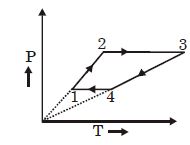
Three moles of an ideal monoatomic gas perform a cycle as shown in the figure. The gas temperature in different states are: $T_1 = 400\, K, T_2 = 800\, K, T_3 = 2400\,K$ and $T_4 = 1200\,K.$ The work done by the gas during the cycle is ........ $kJ$
$SI$ unit of pressure is
The atomic mass of ${ }_6 \mathrm{C}^{12}$ is $12.000000\ \mathrm{u}$ and that of ${ }_6 \mathrm{C}^{13}$ is $13.003354 \ \mathrm{u}$. The required energy to remove a neutron from ${ }_6 \mathrm{C}^{13}$, if mass of neutron is $1.008665 \ \mathrm{u}$, will be :
The r.m.s. velocity of a gas at a certain temperature is $\sqrt 2 $ times than that of the oxygen molecules at that temperature. The gas can be
An electric dipole consisting of two opposite charges of $2 \times {10^{ - 6}}\,C$ each separated by a distance of $3\,cm$ is placed in an electric field of $2 \times {10^5}$ $N/C$. The maximum torque on the dipole will be
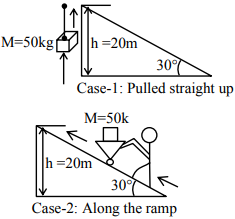
A body of mass 50 kg is lifted to a height of 20 m from the ground in the two different ways as 
shown in the figures. The ratio of work done against the gravity in both the respective cases, 
will be:

Image
The distance between object and its $3$ times magnified virtual image as produced by a convex lens is $20 \mathrm{~cm}$. The focal length of the lens used is $\mathrm{cm}$
A plane electromagnetic wave is propagating along the direction $\frac{\hat{i}+\hat{j}}{\sqrt{2}},$ with its polarization along the direction $\hat{\mathrm{k}}$. The correct form of the magnetic field of the wave would be (here $\mathrm{B}_{0}$ is an appropriate constant)
The torque of force $\vec F =  - 2\hat i + 2\hat j + 3\hat k$ acting on a point $\vec r = \hat i - 2\hat j + \hat k$ about origin will be
In an amplitude modulation, a modulating signal having amplitude of $X$ Volt is superimposed with a carrier signal of amplitude $Y$ Volt in first case. Then, in second case, the same modulating signal is superimposed with different carrier signal of amplitude $2 Y$ Volt. The ratio of modulation index in the two case respectively will be: