MCQ
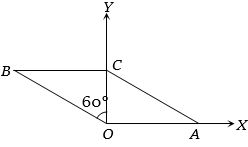
The horizontal force and the force inclined at an angle ${60^o}$ with the vertical, whose resultant is in vertical direction of  $ P $ $kg$, are
  • A
    $P, 2P$
  • B
    $P,\,\,P\sqrt 3 $
  • $2P,\,\,P\sqrt 3 $
  • D
    None of these

Answer

Correct option: C.
$2P,\,\,P\sqrt 3 $
c
(c) Let $\overrightarrow {OA} = {P_1}i,$ $\overrightarrow {CB} = - {P_1}i,$

$\overrightarrow {OB} = - {P_1}i + Pj$

$\frac{{\overrightarrow {OB} \,.\,j}}{{OB}} = \cos 60^\circ \Rightarrow \frac{{( - {P_1}i + Pj)\,.\,j}}{{\sqrt {P_1^2 + {P^2}} }} = \frac{1}{2}$

$ \Rightarrow 2P = \sqrt {{P^2} + P_1^2} \Rightarrow {P_1} = P\sqrt 3 $

$|\overrightarrow {OB} |\, = \sqrt {{P^2} + P_1^2} = \sqrt {{P^2} + 3{P^2}} = 2P.$
Need a full question paper?

Generate a complete, print-ready paper with questions like this in minutes — across 16+ boards, with answer keys.

Start Generating Free

Similar questions

The line $y = mx$ bisects the area enclosed by lines $\text{x}=0,\text{y}=0$ and $\text{x}=\frac{3}{2}$ and the curve $\text{y}=1+4\text{x}-\text{x}^2.$ Then the value of m is:
The length and foot of the perpendicular from the point $(2, -1, 5)$ to the line $\frac{{x - 11}}{{10}} = \frac{{y + 2}}{{ - 4}} = \frac{{z + 8}}{{ - 11}}$ are
$(2, -3, -1) 2x - 3y + 6z + 7 = 0:$
The integrating factor of the differential equation $(\text{x}\log\text{x})\frac{\text{dy}}{\text{dx}}+\text{y}=2\ \log\text{x}$ is given by :
$y = ke^{\sin ^{-1} x} + 3$ is a solution of differeulial equation :-
The projection of the vector $\hat{\text{i}}+\hat{\text{j}}+\hat{\text{k}}$ along the vector of $\hat{\text{j}}$ is:
Area of the region bounded by rays $|x| + y = 1$ and $X -$ axis is $ ........$
A matrix consisting of a single column of $m$ elements is know as:
Let $\ell_1$ and $\ell_2$ be the lines $\overrightarrow{\mathfrak{1}}_1=\lambda(\hat{\mathrm{i}}+\hat{\mathrm{j}}+\hat{\mathrm{k}})$ and $\vec{r}_2=(\hat{\mathrm{j}}-\hat{\mathrm{k}})+\mu(\hat{\mathrm{i}}+\hat{\mathrm{k}})$, respectively. Let $\mathrm{X}$ be the set of all the planes $\mathrm{H}$ that contain the line $\ell_1$. For a plane $\mathrm{H}$, let $\mathrm{d}(\mathrm{H})$ denote the smallest possible distance between the points of $\ell_2$ and $H$. Let $\mathrm{H}_0$ be plane in $X$ for which $\mathrm{d}\left(\mathrm{H}_0\right)$ is the maximum value of $\mathrm{d}(\mathrm{H})$ as $\mathrm{H}$ varies over all planes in $\mathrm{X}$.

Match each entry in List-$I$ to the correct entries in List-$II$.

List-$I$  List-$II$ 
($P$) The value of $\mathrm{d}\left(\mathrm{H}_0\right)$ is ($1$) $\sqrt{3}$
($Q$) The distance of the point $(0,1,2)$ from $\mathrm{H}_0$ is ($2$) $\frac{1}{\sqrt{3}}$
($R$) The distance of origin from $\mathrm{H}_0$ is ($3$) $0$
($S$) The distance of origin from the point of intersection of planes $\mathrm{y}=\mathrm{z}, \mathrm{x}=1$ and $\mathrm{H}_0$ is ($4$) $\sqrt{2}$
  ($5$) $\frac{1}{\sqrt{2}}$

The corret option is :

Let $f(x)=\left\{\begin{array}{l}\left|4 x^{2}-8 x+5\right| \text {, if } 8 x^{2}-6 x+1 \geq 0 \\ {\left[4 x^{2}-8 x+5\right] \text {, if } 8 x^{2}-6 x+1<0}\end{array}\right.$, where $[\alpha]$ denotes the greatest integer less than or equal to $\alpha$. Then the number of points in $R$ where $f$ is not differentiable is $.......$