MCQ
The horizontal range is four times the maximum height attained by a projectile. The angle of projection is  .......... $^o$
  • A
    $90$
  • B
    $60$
  • $45$
  • D
    $30$

Answer

Correct option: C.
$45$
c
$R=4 H$

$\frac{\mathrm{U}^{2} \times 2 \sin \theta \cos \theta}{\mathrm{g}}=4 \times \frac{\mathrm{U}^{2} \sin ^{2} \theta}{2 \mathrm{g}}$

$\tan \theta=1 \quad\left[\theta=45^{\circ}\right]$

Need a full question paper?

Generate a complete, print-ready paper with questions like this in minutes — across 16+ boards, with answer keys.
Start Generating Free

Similar questions

An engine pumps water through a hose pipe. Water passes through the pipe and leaves it with a velocity of $2\, m/s$. The mass per unit length of water in the pipe is $100\, kg/m.$ What is the power of the engine $?$ ................ $\mathrm{W}$
Consider a $1\, c.c.$ sample of air at absolute temperature ${T_0}$ at sea level and another $1 cc$ sample of air at a height where the pressure is one-third atmosphere. The absolute temperature $T$ of the sample at that height is
An object is allowed to fall from a height $R$ above the earth, where $R$ is the radius of earth. Its velocity when it strikes the earth's surface, ignoring air resistance, will be :
Which of the following diagrams does not represent a streamline flow?
A body cools down from $65^\circ C$ to $60^\circ C$ in $5$ minutes. It will cool down from $60^\circ C$ to $55^\circ C$ in:
A couple produces:
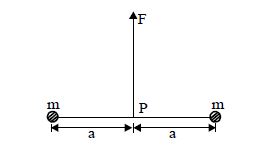
Two particles of mass $m$ each are tied at the ends of a light string of length $2a$ . The whole system is kept on a frictionless horizontal surface with the string held tight so that each mass is at a distance $'a'$ from the centre $P$ (as shown in the figure). Now, the mid-point of the string is pulled vertically upwards with a small but constant force $F$ . As a result, the particles move towards each other on the surface. The magnitude of acceleration, when the separation between them becomes $2x$ , is
A vector ${\overrightarrow F _1}$is along the positive $X-$axis. If its vector product with another vector ${\overrightarrow F _2}$ is zero then ${\overrightarrow F _2}$ could be
A body dropped from a height $1\,m$ on a floor rises to a height $25\,cm$ after first  rebound. The coefficient of restitution is :-
A situation may be described by using different sets of coordinate axes having different orientations. Which of the following do not depend on the orientation of the axes?