MCQ
The hydration of propyne results in formation of
  • Acetone
  • B
    Propanol $- 1$
  • C
    Propene
  • D
    Propanal

Answer

Correct option: A.
Acetone
a
$\underset{\Pr opyne}{\mathop{C{{H}_{3}}-C\equiv CH}}\,\,+\,{{H}_{2}}O\xrightarrow[HdS{{O}_{4}}]{{{H}_{2}}S{{O}_{4}}}$ $\underset{\begin{smallmatrix} 
 2\,-\,\Pr opane \\ 
 (unstable) 
\end{smallmatrix}}{\mathop{\left[ \begin{matrix}
   \,\,\,\,OH  \\
   |\,  \\
   C{{H}_{3}}-C=C{{H}_{2}}  \\
\end{matrix} \right]}}\,$ $\leftrightarrow $ $\underset{\begin{smallmatrix} 
 2\,-\,\Pr opane \\ 
 (acetone) 
\end{smallmatrix}}{\mathop{\begin{matrix}
   \,\,\,\,O\,\,\,  \\
   ||  \\
   C{{H}_{3}}-C-C{{H}_{3}}  \\
\end{matrix}}}\,$

Need a full question paper?

Generate a complete, print-ready paper with questions like this in minutes — across 16+ boards, with answer keys.

Start Generating Free

Similar questions

In an electrochemical reaction of lead, at standard temperature, if $E _{\left( Pb ^{2+} / Pb \right)}^0= m$ Volt and $E _{\left( Pb ^{4+} / Pb \right)}^0= n$ Volt, then the value of $E _{\left( Pb ^{2+} / Pb ^{4+}\right)}^0$ is given by $m-x n$. The value of $x$ is $...........$. (Nearest integer)
  Column $I$   Column $II$
$(A)$ Kohlrausch law can calculate $(P)$ $\frac{{\Lambda _m^c}}{{\Lambda _m^o}}$
$(B)$ Molar conductance ${\Lambda _m}$ $(Q)$ $\frac{1}{R} \times \frac{l}{A}$
$(C)$ Specific conductance Kappa $\to (k)$ $(R)$ $\Lambda _m^o\,of\,c{a_3}{(P{O_4})_2}$
$(D)$ Degree of ionization of weak electrolyte $(S)$ $\frac{{k \times 1000}}{M}$

Which of the following option show correct matches

The correct structure of product '$P$' in the following reaction is

Asn - Ser  $+\,\underset{(excess)}{\mathop{{{(C{{H}_{3}}CO)}_{2}}O}}\,\xrightarrow{NE{{t}_{3}}}P$

Which of the following molecule would have a carbon halogen bond most susceptible to nucleophilic substitution?
Which one of the following $0.10\, \mathrm{M}$ aqueous solutions will exhibit the largest freezing point depression?
A gaseous mixture of two substances $A$ and $B$, under a total pressure of $0.8\,atm$ is in equilibrium with an ideal liquid solution. The mole fraction of substance $A$ is $0.5$ in the vapour phase and $0.2$ in the liquid phase. The vapour pressure of pure liquid $A$ $......$ is atm. (Nearest integer)
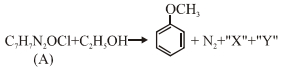
$[Image]$

In the above reaction, the structural formula of $(A), "X"$ and $"Y"$ respectively are :
Due to the presence of ambidentate ligands coordination compounds show isomerism. Palladium complexes of the type $\left[\mathrm{Pd}\left(\mathrm{C}_6 \mathrm{H}_5\right)_2(\mathrm{SCN})_2\right]$ and $\left[\mathrm{Pd}\left(\mathrm{C}_6 \mathrm{H}_5\right)_2(\mathrm{NCS})_2\right]$ are
Mark the element which displaces three halogens from their compounds
Which of the following statements is not applicable to electrolytic conductors