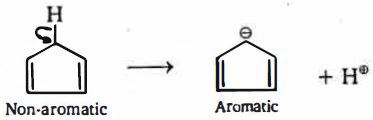
MCQ
the hydrogen indicated by arrow will be easily removed as
  • $H^+$
  • B
    ${H^\circleddash }$
  • C
    ${H^ \bullet }$
  • D
    ${H^{ - 2}}$

Answer

Correct option: A.
$H^+$
a

Need a full question paper?

Generate a complete, print-ready paper with questions like this in minutes — across 16+ boards, with answer keys.

Start Generating Free

Similar questions

The number of non-polar molecules from the following is__________

$\mathrm{HF}, \mathrm{H}_2 \mathrm{O}, \mathrm{SO}_2, \mathrm{H}_2, \mathrm{CO}_2, \mathrm{CH}_4, \mathrm{NH}_3, \mathrm{HCl}, \mathrm{CHCl}_3, \mathrm{BF}_3$

Compare the properties of metals and non-metals with respect to electronic configuration.
Quantum theory was postulated by :
The equivalent weight of $H_3PO_4$ in the reaction

$Ca(OH)_2 + H_3PO_4\to CaHPO_4 + 2H_2O$ is

The enthalpy change $(\Delta H)$ for the neutralisation of $1\,M\,HCl$ by caustic potash in dilute solution at $298\,K$ is .....$kJ$
What effect is observed, on the size of an atom when an electron is removed and in another case an electron is added to the same atom?
What are A and B in following reaction?

$ \ \ \ \ \ \ \ \ \ \ \ \ \ \text{H}\\ \ \ \ \ \ \ \ \ \ \ \ \ \ |\\\text{H}_2\text{C}-\text{C}-\text{H}+\text{KOH}\xrightarrow{\text{Alcohol}}\text{A}\xrightarrow{\text{NaNH}_2}\text{B}\\ \ \ \ \ \ \ | \ \ \ \ \ \ |\\ \ \ \ \ \ \text{Br} \ \ \ \text{Br}$

 
A
B
(a)

$\text{H}_2\text{C}=\text{CH}_2$

$\text{CH}\equiv\text{CH}$

(b)

$\text{CH}_2=\text{CHBr}$

$\text{CH}\equiv\text{CH}$

(c)

$\text{CH}_2=\text{CHBr}$

$\text{CH}_2=\text{CH}_2$

(d)

$\text{CH}_2=\text{CH}_2$

$\text{CH}\equiv\text{CBr}$

Order of Covalent bond;

$A.$ $KF > KI ; LiF > KF$

$B.$ $KF < KI ; LiF > KF$

$C.$ $SnCl _4 > SnCl _2 ; CuCl > NaCl$

$D.$ $LiF > KF ; \quad CuCl < NaCl$

$E.$ $KF < KI ; CuCl > NaCl$

$8\, mol$ of $AB_3(g)$ are introduced into a $1.0\, dm^3$ vessel. If it dissociates as

$2A{B_3}(g) \rightleftharpoons {A_2}(g) + 3{B_2}(g)$. At equilibrium, $2\, mol$ of $A_2$ are found to be present. The equilibrium constant of this reaction is

$2\,mol$ of zinc is dissolved in $HCl$ at $25\,^oC.$ The work done is open vessel