MCQ
The hydrogen ion concentration of $0.001 $ $M\,\,NaOH$ solution is
  • A
    $1 \times {10^{ - 2}}\,mole/litre$
  • $1 \times {10^{ - 11}}\,mole/litre$
  • C
    $1 \times {10^{ - 14}}\,mole/litre$
  • D
    $1 \times {10^{ - 12}}\,mole/litre$

Answer

Correct option: B.
$1 \times {10^{ - 11}}\,mole/litre$
(b) $0.001\, M$ $NaOH$ means $[O{H^ - }] = {10^{ - 3}}$; $pOH = 3$

$pH + pOH = 14;\,\,pH = 14 - 3$

$pH = 11$; $[{H^ + }] = {10^{ - 11}}$ $mole-litre$$^{-1}$

Need a full question paper?

Generate a complete, print-ready paper with questions like this in minutes — across 16+ boards, with answer keys.
Start Generating Free

Similar questions

The stage of hybridization of central atom in dimer of $BH_3$ and $BeH_2$ is
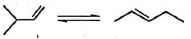
The heat of hydrogenation for $3$ -methylbutene and $2$ -pentene are $-30\, kcal/mol$ and $-28\,kcal/mol$ respectively. The heats of combustion of $2$ -methylbutane and  pentane are - $784 \,kcal / mol$ and $-782 \,kcal/mol$ respectively. All the values are  given under standard conditions. Taking into account that combustion of both alkanes  give the same products, what is $\Delta H$ (in $kcal/mol$) for the following reaction under  same conditions ?
If an aqueous solution of glucoseis allowed to freeze than crystal of which will be separated out first
On dissolving $0.5 g$ of a non-volatile non-ionic solute to $39 g$ of benzene, its vapor pressure decreases from $650 mm Hg$ to $640 mm Hg$. The depression of freezing point of benzene (in $K$ ) upon addition of the solute is. . . . .

(Given data : Molar mass and the molal freezing point depression constant of benzene are $78 g mol ^{-1}$ and $5.12 K kg mol ^{-1}$, respectively)

The most stable oxidation state of $Cr$ in aq. medium is
The reference compound `iso-octane' which is used in determining the octane number of gasoline has the structure
Which of the following $C_6H_6$ compounds has a single set of structurally  equivalent hydrogen atoms ?
The number of non-polar molecules from the following is__________

$\mathrm{HF}, \mathrm{H}_2 \mathrm{O}, \mathrm{SO}_2, \mathrm{H}_2, \mathrm{CO}_2, \mathrm{CH}_4, \mathrm{NH}_3, \mathrm{HCl}, \mathrm{CHCl}_3, \mathrm{BF}_3$

If first orbit energy of $H{e^ + }$ is $-54.4 \,eV$, then the second orbit energy will be ............. $\mathrm{eV}$
The unit of specific reaction rate constant for a first order (if the concentration expressed in molarity) would be