MCQ
The $ICl$ molecule is
  • A
    Purely electrovalent
  • B
    Purely covalent
  • C
    Polar with negative end on iodine
  • Polar with negative end on chlorine

Answer

Correct option: D.
Polar with negative end on chlorine
(d) Due to the electronegativity difference.

Need a full question paper?

Generate a complete, print-ready paper with questions like this in minutes — across 16+ boards, with answer keys.

Start Generating Free

Similar questions

The ground state energy of hydrogen atom is $-13.6\, eV$. The energy of second excited state of $He^+$ ion in $eV$ is
Which of the following is not tetrahedral
If in the reaction ${N_2}{O_4} = 2N{O_2},\,\alpha $ is that part of ${N_2}{O_4}$ which dissociates, then the number of moles at equilibrium will be
Bond energies in $NO,\,N{O^ + }$ and $N{O^ - }$ are such as
Which of the following species has polar and non-polar bonds but molecule as a  whole is non-polar ?
To measure the quantity of $MnCl _2$ dissolved in an aqueous solution, it was completely converted to $KMnO _4$ using the reaction,

$MnCl _2+ K _2 S _2 O _8+ H _2 O \longrightarrow KMnO _4+ H _2 SO _4+ HCl$ (equation not balanced).

Few drops of concentrated $HCl$ were added to this solution and gently warmed. Further, oxalic acid ( $225 mg$ ) was added in portions till the colour of the permanganate ion disappeared. The quantity of $MnCl _2$ (in $mg$ ) present in the initial solution is. . . . . . . . . (Atomic weights in $g mol ^{-1}: Mn =55, Cl =35.5$ )

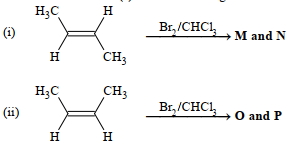
The correct statement(s) for the following addition reactions is(are)

(IMAGE)

$[A]$ ( $M$ and $O)$ and ( $N$ and $P$ ) are two pairs of diastereomers

$[B]$ Bromination proceeds through trans-addition in both the reactions

$[C]$ $O$ and $P$ are identical molecules

$[D]$ (M and $O)$ and ( $N$ and $P)$ are two pairs of enantiomers
Assertion : For Balmer series of hydrogen spectrum, the value $n_1 = 2$ and $n_2 = 3, 4, 5.$
Reason : The value of $n$ for a line in Balmer series of hydrogen spectrum having the highest wave length is $4$ and $6$.
Amongst the following the total number of species NOT having eight electrons around central atom in its outermost shell, is $NH _3, AlCl _3, BeCl _2, CCl _4, PCl _5:$
Which of the following quantum number is not obtained by the solution of Schrodinger wave equation