Question
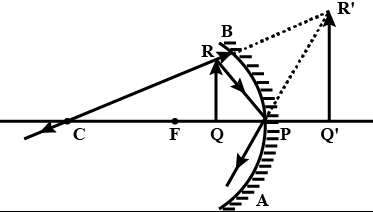
The image formed behind a mirror and a virtual image:

Answer

  1. Are of same nature
Explanation:
The image formed behind a mirror is virtual in nature. So, they are of the same nature always.

Need a full question paper?

Generate a complete, print-ready paper with questions like this in minutes — across 16+ boards, with answer keys.
Start Generating Free

Similar questions

The nature of binding for a crystal with alternate and evenly spaced positive and negative ions is(a) Covalent(b) Metallic(c) Dipolar(d) Ionic
       
A modified discharge tube is used as a ________:
Find the false statement.
A converging lens is used to form an image on a screen. When upper half of the lens is covered by an opaque screen(a) Half the image will disappear(b) Complete image will be formed of same intensity(c) Half image will be formed of same intensity(d) Complete image will be formed of decreased intensity


A steady current of $5$ amps is maintained for $45$ mins . During this time it deposits $4.572 \ gm$ of zinc at the cathode of a voltameter. $\text{E.C.E.}$ of zinc is
The resistance of the series combination of two resistance is S. When they are joined in parallel the total resistance is P. If S = nP, then the minimum possible value of n is(a) 4(b) 3(c) 2(d) 1
       
The two rails of a railways track, insulated from each other and the ground, are connected to a milli voltmeter. What is the reading of the milli voltmeter when a train travels at a speed of $20\ ms^{-1}$ along the track, given that the vertical component of the earth's magnetic field is $0.2 \times 10^{-4} Wbm^{-2}$ and the rails are separated by $1m$?
Wavefront means(a) All particles in it have same phase(b) All particles have opposite phase of vibrations(c) Few particles are in same phase, rest are in opposite phase(c) Few particles are in same phase, rest are in opposite phase(d) None of these


An electron $($mass $=9 \times 10^{-31} \mathrm{~kg}$. Charge $=1.6 \times 10^{-19} \mathrm{C} )$ whose kinetic energy is $7.2 \times 10^{-18}$ joule is moving in a circular orbit in a magnetic field of $9 \times 10^{-5}$ weber $/ \mathrm{m}^2$. The radius of the orbit is
A voltmeter has a range $0-\mathrm{V}$ with a series resistance $R$. With a series resistance $2 R$, the range is $0-\mathrm{V}^{\prime}$. The correct relation between $\mathrm{V}^{\prime}$ and $\mathrm{V}^{\prime}$ is