Question
The index of refraction of fused quartz is 1.472 for light of wavelength 400nm and is 1.452 for light of wavelength 760nm. Find the speeds of light of these wavelengths in fused quartz.

Answer

We know that, $\frac{\mu_2}{\mu_1}=\frac{\text{v}_1}{\text{v}_2}$So, $\frac{1472}{1}=\frac{3\times10^8}{\text{v}_{400}}\Rightarrow\text{v}_{400}=2.04\times10^8\text{m/sec}.$
[because, for air, $\mu=1\ \text{and v}=3\times10^8\text{m/s}]$
Again, $\frac{1452}{1}=\frac{3\times10^8}{\text{v}_{760}}\Rightarrow\text{v}_{760}=2.07\times10^8\text{m/sec}.$

Need a full question paper?

Generate a complete, print-ready paper with questions like this in minutes — across 16+ boards, with answer keys.
Start Generating Free

Similar questions

The temperature of equal masses of three different liquids $\mathrm{A}, \mathrm{B}$ and C are $12^{\circ} \mathrm{C}, 19^{\circ} \mathrm{C}$ and $28^{\circ} \mathrm{C}$ respectively. The temperature when A and B are mixed is $16^{\circ} \mathrm{C}$. When B and C are mixed, the temperature is $23^{\circ} \mathrm{C}$. What would be the temperature when A and C are mixed?
A hydrogen atom in state $n = 6$ makes two successive transitions and reaches the ground state. In the first transition a photon of $1.13eV$ is emitted. $(a)$ Find the energy of the photon emitted in the second transition $(b)$ What is the value of n in the intermediate state?
Consider the situation of the previous question from a frame moving with a speed v0 parallel to the initial velocity of the block.
  1. What are the initial and final kinetic energies?
  2. What is the work done by the kinetic friction?
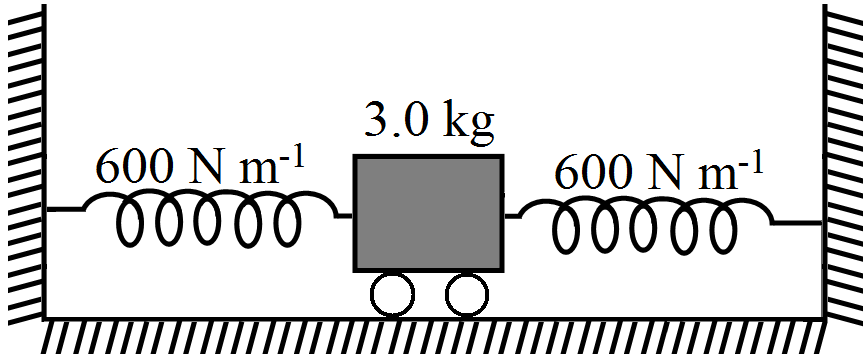
A trolley of mass $3.0\ kg$, as shown in Figure, is connected to two springs, each of spring constant $600Nm^{-1}$. If the trolley is displaced from its equilibrium position by $5.0\ cm$ and released, what is $(a)$ the period of ensuing oscillations, and $(b)$ the maximum speed of the trolley? How much energy is dissipated as heat by the time trolley comes to rest due damping forces?
The first excited energy of a $He^+$ ion is the same as the ground state energy of hydrogen. Is it always true that one of the energies of any hydrogen-like ion will be the same as the ground state energy of a hydrogen atom?
The intensity of sound from a point source is $1.0 \times 10^{-6}W/m^2$ at a distance of 5.0m from the source. What will be the intensity at a distance of 25m from the source?
Consider the situation of the previous problem. A particle having charge q and mass m is projected from the point Q in a direction going into the plane of the diagram. It is found to describe a circle of radius r between the two plates. Find the speed of the charged particle.
The final volume of a system is equal to the initial volume in a certain process. Is the work done by the system necessarily zero? Is it necessarily non-zero.
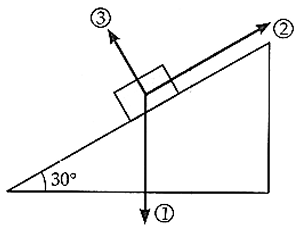
A block of wood of mass 3 kg is resting on the surface of a rough inclined surface, inclined at an angle $\theta$ as shown in the figure.
Image
a. Name the forces $(1,2,3)$.
b. If the coefficient of static friction is 0.2 , calculate the value of all three forces.
$
\text { (use } g=10 m / s^2 \text { ) }
$
State parallelogram law of vector addition. Show that resultant of two vectors A and B inclined at an angle $\theta$ is $\text{R}=\sqrt{\text{A}^2+\text{B}^2+2\text{AB}\cos\theta}.$