MCQ
The instantaneous angular position of a point on a rotating wheel is given by the equation $\theta(t)=2 t^3-6 t^2$. The torque on the wheel becomes zero at
  • A
    $t =0.25 s$
  • B
    $t =0.5 s$
  • C
    $t=2 s$
  • D
    $t=1 s$

Need a full question paper?

Generate a complete, print-ready paper with questions like this in minutes — across 16+ boards, with answer keys.
Start Generating Free

Similar questions

The temperature of two bodies $A$ and $B$ are respectively, $727^\circ C$ and $327^\circ C.$ The ratio $H_A :H_B$ of the rates of heat radiated by them is:
From the top of a tower, two stones whose masses are in the ratio $1 : 2$ are thrown, one straight up with an initial speed $u$ and the second straight down with same speed $u.$ neglecting air resistance,
The length of second's hand in a watch is $1 \,cm.$ The change in velocity of its tip in $15\, seconds$ is
Let $F_{p p^{\prime}} F_{p n}$ and $F_{n n}$ fill denote the magnitudes of the nuclear force by a proton on a proton, by a proton on a neutron and by a neutron on a neutron respectively. When the separation is $1 fm :$
The displacement of the particle varies with time according to the relation $x = \frac{k}{b}\,[1 - {e^{ - bt}}]$. Then the velocity of the particle is
The distance between two stars of masses $3 M_S$ and $6 M_S$ is $9 R$. Here $R$ is the mean distance between the centers of the Earth and the Sun, and $M_S$ is the mass of the Sun. The two stars orbit around their common center of mass in circular orbits with period $n T$, where $T$ is the period of Earth's revolution around the Sun. The value of $n$ is. . . . .
A wire of diameter $1\ mm$ breaks under a tension of $1000N.$ Another wire of same material as that of the first one, but of diameter $2\ mm$ breaks under a tension of:
$1\, g$ of a steam at $100°C$ melt ........ $gm$ ice at $0°C\,?$ $($Latent heat of ice $= 80 \,cal/gm$ and latent heat of steam $= 540\, cal/gm)$
The kinetic energy of one gram molecule of a gas at normal temperature and pressure is $(R = 8.31\,J/mole - K)$
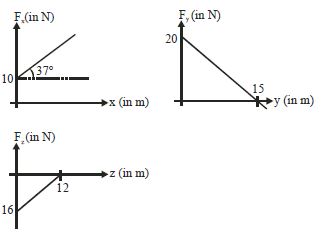
The components of a force acting on a particle are varying according to the graphs shown. To reach at point $B\, (8, 20, 0)$ from point $A\,(0, 5, 12)$ the particle moves on paths parallel to $x-$ axis then $y-$ axis and then $z-$ axis, then work done by this force is ............ $\mathrm{J}$