MCQ
The integral $\int \limits_{0}^{2} \| x-1|-x| d x$ is equal to
  • $1.5$
  • B
    $2.5$
  • C
    $0.5$
  • D
    $3.5$

Answer

Correct option: A.
$1.5$
a
$\int_{0}^{2}|x-1|-x \mid \mathrm{d} x$

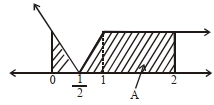
Let $f(x) \| x-1|-x|$

$=\left\{\begin{array}{ll}1, & x \geq 1 \\ |1-2 x|, & x \leq 1\end{array}\right.$

$A=\frac{1}{2}+1=\frac{3}{2}$

Or

$\int_{0}^{1 / 2}(1-2 x) d x+\int_{1 / 2}^{1}(2 x-1)+\int_{0}^{2} 1 d x$

$=\left[x-x^{2}\right]_{0}^{\frac{1}{2}}+\left[x^{2}-x\right]_{1 / 2}^{1}+[x]_{1}^{2}$

$=3 / 2$
Need a full question paper?

Generate a complete, print-ready paper with questions like this in minutes — across 16+ boards, with answer keys.

Start Generating Free

Similar questions

The value of ${\cos ^2}\frac{\pi }{{12}} + {\cos ^2}\frac{\pi }{4} + {\cos ^2}\frac{{5\pi }}{{12}}$ is
If $A$ and $B$ are events such that $P(A \cup B) = 3/4,$ $P(A \cap B) = 1/4,$ $P(\bar A) = 2/3,$ then $P(\bar A \cap B)$ is
Which of the following function $(s)$ not defined at $x = 0$ has/have irremovable discontinuity at $x = 0$ ?
Let $A =\left[\begin{array}{ccc}2 & -1 & -1 \\ 1 & 0 & -1 \\ 1 & -1 & 0\end{array}\right]$ and $B = A - I$. If $\omega=\frac{\sqrt{3} i -1}{2}$ then the number of elements in the set $\left\{ n \in\{1,2, \ldots, 100\}: A ^{ n }+(\omega B )^{ n }= A + B \right\}$ is equal to $..........$
Let $S$ be the infinite sum given by $S=\sum \limits_{n=0}^{\infty} \frac{a_n}{10^{2 n}}$ where $\left(a_n\right)_{n \geq 0}$ is a sequence defined by $a_0=a_1=1$ and $a_j=20 a_{j-1}-108 a_{j-2}$ for $j \geq 2$. If $S$ is expressed in the form $\frac{a}{b}$, where $a, b$ are coprime positive integers, then $a$ equals
If $P $ and  $ Q $ be the middle points of the sides $BC$  and $ CD$  of the parallelogram $ABCD$ , then $\overrightarrow {AP} + \overrightarrow {AQ} = $
$\operatorname{Lim}_{n \rightarrow \infty}\left\{\left(2^{\frac{1}{2}}-2^{\frac{1}{3}}\right)\left(2^{\frac{1}{2}}-2^{\frac{1}{5}}\right) \ldots \ldots\left(2^{\frac{1}{2}}-2^{\frac{1}{2 n+1}}\right)\right\}$ is equal to
Suppose the sum of the first $m$ terms of an arithmetic progression is $n$ and the sum of its first $n$ terms is $m$, where $m \neq n$. Then, the sum of the first $(m+n)$ terms of the arithmetic progression is
The equation of the circle which passes through the points $(2, 3)$ and $(4, 5)$ and the centre lies on the straight line $y - 4x + 3 = 0$, is
Different $A.P.$'s are constructed with the first term $100$,the last term $199$,And integral common differences. The sum of the common differences of all such, $A.P$'s having at least $3$ terms and at most $33$ terms is.