MCQ
The integral $\int \limits_{0}^{2} \| x-1|-x| d x$ is equal to
  • $1.5$
  • B
    $2.5$
  • C
    $0.5$
  • D
    $3.5$

Answer

Correct option: A.
$1.5$
a
$\int_{0}^{2}|x-1|-x \mid \mathrm{d} x$

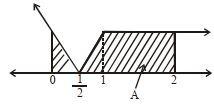
Let $f(x) \| x-1|-x|$

$=\left\{\begin{array}{ll}1, & x \geq 1 \\ |1-2 x|, & x \leq 1\end{array}\right.$

$A=\frac{1}{2}+1=\frac{3}{2}$

Or

$\int_{0}^{1 / 2}(1-2 x) d x+\int_{1 / 2}^{1}(2 x-1)+\int_{0}^{2} 1 d x$

$=\left[x-x^{2}\right]_{0}^{\frac{1}{2}}+\left[x^{2}-x\right]_{1 / 2}^{1}+[x]_{1}^{2}$

$=3 / 2$
Need a full question paper?

Generate a complete, print-ready paper with questions like this in minutes — across 16+ boards, with answer keys.

Start Generating Free

Similar questions

If $y=5 \cos x-3 \sin x$, then $\frac{d^2 y}{d x^2}=$ _________.
Which of the following functions is decreasing on $\Big(0,\frac{\pi}{2}\Big)?$
The area of the region bounded by $y-x=2$ and $x^{2}=y$ is equal to :
The relation S defined on the set R of all real number by the rule aSb iff a ≥ b is:
  1. An equivalence relation.
  2. Reflexive, transitive but not symmetric.
  3. Symmetric, transitive but not reflexive.
  4. Neither transitive nor reflexive but symmetric.
Let $A=\{(x, y): 2 x+3 y=23, x, y \in N\}$ and $B=\{x:(x, y) \in A\}$. Then the number of one-one functions from $\mathrm{A}$ to $\mathrm{B}$ is equal to ................
Let $g(x)=\log (f(x))$ where $f(x)$ is a twice differentiable positive function on $(0, \infty)$ such that $f(x+1)=x f(x)$. Then, for $\mathrm{N}=1,2,3, \ldots$,

$\mathrm{g}^{\prime \prime}\left(\mathrm{N}+\frac{1}{2}\right)-\mathrm{g}^{\prime \prime}\left(\frac{1}{2}\right)=$

The least value of $'a'$ for which the equation, $\frac{4}{{\sin \,x}}\,\, + \,\,\frac{1}{{1\,\, - \,\,\sin \,x}} = a$ has atleast one solution on the interval $(0, \pi /2)$ is
If $f\left( x \right)\left\{ {\begin{array}{*{20}{c}}
  {\frac{{\sin \,\left( {p + 1} \right)x + \sin \,x}}{x},\,\,}&{x < 0} \\ 
  {q\,\,\,\,\,\,\,\,\,\,\,\,\,\,\,\,\,\,\,\,\,\,\,\,\,\,\,\,\,\,\,\,\,,}&{x = 0} \\ 
  {\frac{{\sqrt {x + {x^2}}  - \sqrt x }}{{x/2}},}&{x > 0} 
\end{array}} \right.$ Is continuous at $x = 0$, then the ordered pair $(p, q)$ is equal to
Let $(x, y, z)$ be points with integer coordinates satisfying the system of homogeneous equations:

$3 x-y-z $$ =0 $, $-3 x+z $$ =0 $, $-3 x+2 y+z $$ =0 .$

Then the number of such points for which $x^2+y^2+z^2 \leq 100$ is

If $A = \left[ {\begin{array}{*{20}{c}}1&0&1\\0&1&1\\1&0&0\end{array}} \right]$, then $A$ is