MCQ
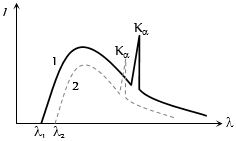
The intensity distribution of $X-$ rays from two coolidge tubes operated on different voltages $V_1$ and $V_2$ and using different target materials of atomic numbers $Z_1$ and $Z_2$ is shown in the figure. Which one of the following inequalities is true?
  • $V_1$ > $V_2$, $Z_1$ < $Z_2$
  • B
    $V_1$ > $V_2$, $Z_1$ > $Z_2$
  • C
    $V_1$ < $V_2$, $Z_1$ > $Z_2$
  • D
    $V_1$ = $V_2$, $Z_1$ < $Z_2$

Answer

Correct option: A.
$V_1$ > $V_2$, $Z_1$ < $Z_2$
a
(a) ${\lambda _{\min }} = \frac{{hc}}{{eV}}$ ==>$\lambda \propto \frac{1}{V}$(see graph)

==>${V_1} > {V_2}$

$\sqrt \nu = a(Z - b)$ Moseley’s law
$\nu \propto {(Z - 1)^2}$

==> $\lambda \propto \frac{1}{{{{(Z - 1)}^2}}}$

${\lambda _1} > {\lambda _2}$ (see graph for characteristic lines)

==>${Z_2} > {Z_1}$.

Need a full question paper?

Generate a complete, print-ready paper with questions like this in minutes — across 16+ boards, with answer keys.

Start Generating Free

Similar questions

Light rays from a source are incident on a glass prism of index of refraction $\mu $ and angle of prism $\alpha $. At near normal incidence, the angle of deviation of the emerging rays is
A bar magnet of length 3 cm has points A and B along its axis at distances of 24 cm and 48 cm on the opposite sides. Ratio of magnetic fields at these points will be
One end of a Nichrome wire of length $2\,L$ and cross-sectional area $A$ is attatched to an end of another Nichrome wire of length $L$ and cross-sectional area $2\,A$. If the free end of the longer wire is at an electric potential of $8.0$ $\mathrm{volts}$, and the free end of the shorter wire is at an electric potential of $1.0$ $\mathrm{volt}$, the potential at the junction of the two wires is equal to ............. $V$
According to Joule's law, if the potential difference across a conductor having a material of specific resistance remains constant, then the heat produced in the conductor is directly proportional to
Pick out the apparatus used in the experiment of the photoelectric effect from the following.
A moving coil galvanometer is converted into an ammeter reading upto $0.03\,A$ by connecting a shunt of resistance $4r$ across it and into an ammeter reading upto $0.06\,A$ when a shunt of resistance $r$ is connected across it. What is the maximum current which can be sent through this galvanometer if no shunt is used ............... $A$
Electrons move at right angles to a magnetic field of $1.5 \times 10^{-2}$ Tesla with a speed of $6 \times 10^7 \mathrm{~m} / \mathrm{s}$. If the specific charge of the electron is $1.7 \times 10^{11} \mathrm{C} / \mathrm{kg}$. The radius of the circular path will be
Two students $P$ and $Q$ perform an experiment to verify Ohm's law for a conductor with resistance $R$. They use a current source and a voltmeter with least counts of $0.1 mA$ and $0.1 \,mV$, respectively. The plots of the variation of voltage drop $V$ across $R$ with current $I$ for both are shown below. The statement which is most likely to be correct?
In a photoelectric experiment a parallel beam of monochromatic light with power of $200 W$ is incident on a perfectly absorbing cathode of work function $6.25 eV$. The frequency of light is just above the threshold frequency so that the photoelectrons are emitted with negligible kinetic energy. Assume that the photoelectron emission efficiency is $100 \%$. A potential difference of $500 V$ is applied between the cathode and the anode. All the emitted electrons are incident normally on the anode and are absorbed. The anode experiences a force $F = n \times 10^{-4} N$ due to the impact of the electrons. The value of $n$ is. . . . .

Mass of the electron $m _{ c }=9 \times 10^{-31} kg$ and $1.0 eV =1.6 \times 10^{-19} J$.

In the hydrogen atom, an electron makes a transition from $n = 2$ to $n = 1$. The magnetic field produced by the circulating electron at the nucleus?