Question
The intensity of sound wave while passing through an elastic medium falls down by $10\%$ as it covers one metre distance through the medium. If the initial intensity of the sound wave was $100$ decibels, its value after it has passed through $3$ metre thickness of the medium will be .... $decibel$
Answer

(b) After passing the $3$ meter intensity is given by 

${I_3} = \frac{{90}}{{100}} \times \frac{{90}}{{100}} \times \frac{{90}}{{100}} \times I = 72.9\% \;{\rm{of }}I$ 

So, the intensity is $72.9$ decibel.

Need a full question paper?

Generate a complete, print-ready paper with questions like this in minutes — across 16+ boards, with answer keys.

Start Generating Free

Similar questions

If an alternating voltage is represented as $E = 141\,sin\, (628\,t),$ then the rms value of the voltage and the frequency are respectively
A galvanometer of resistance $100\,\Omega $ has $50\, divisions$ on its scale and has sensitivity of $20\,\mu A / division$. It is to be converted to a voltmeter with three ranges, of $0-2\, V$, $0-10\, V$ and $0-20\, V$. The appropriate circuit to do so is
A dip needle vibrates in the vertical plane perpendicular to the magnetic meridian. The time period of vibration is found to be $2$ seconds. The same needle is then allowed to vibrate in the horizontal plane and the time period is again found to be $2$ seconds. Then the angle of dip is.....$^o$
A wagon weighing $1000\, kg$ is moving with a velocity $50\,km/h$ on smooth horizontal rails. A mass of $250 \,kg$ is dropped into it. The velocity with which it moves now is ......... $km/hour$
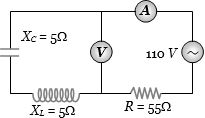
The reading of ammeter in the circuit shown will be.....$A$
Which of the following is self adjusting in nature?
Semiconductor is damaged by the strong current due to
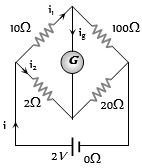
In the circuit shown below the resistance of the galvanometer is $20\, \Omega$ . In which case of the following alternatives are the currents arranged strictly in the decreasing order
$STATEMENT-1$ For practical purposes, the earth is used as a reference at zero potential in electrical circuits.and

$STATEMENT-2$ The electrical potential of a sphere of radius $R$ with charge $\mathrm{Q}$ uniformly distributed on the surface is given by $\frac{\mathrm{Q}}{4 \pi \varepsilon_0 R}$.

The charge per unit length of the four quadrant of the ring is $2\ \lambda , - 2\ \lambda , \lambda$ and $- \lambda$ respectively. The electric field at the centre is