MCQ
The interval on which the function f(x) = 2x3 + 9x2 + 12x - 1 is decreasing is:
  • A
    $[-1,\infty)$
  • B
    $[-2,-1]$
  • C
    $(-\infty ,-2]$
  • D
    $[-1,1]$

Answer

  1.  $[-2,-1]$

Solution:

We have, f(x) = 2x3 + 9x2 + 12x - 1

$\therefore$ f'(x) = 6x2 + 18x + 12

= 6(x2 + 3x + 2) = 6(x + 2)(x + 1)

So, $\text{f}'(\text{x})\leq0,$ for decreasing.

On drawing number lines as below.
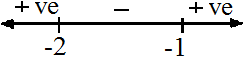
We see that f'(x) is decreasing in [-2, -1].

Need a full question paper?

Generate a complete, print-ready paper with questions like this in minutes — across 16+ boards, with answer keys.

Start Generating Free

Similar questions

Two events A and B will be independent, if

  1. A and B are mutually exclusive

  2. $\text{P}(\text{A}'\text{B}')=\big[1-\text{P}(\text{A})\big]\big[1-\text{P}(\text{B})\big]$

  3. P(A) = P(B)

  4. P(A) + P(B) = 1

If $\text{A}=\begin{bmatrix}\text{i}&0\\0&\text{i}\end{bmatrix},\text{n}\in\text{N},$ then A4n equals:

  1. $\begin{bmatrix}0&\text{i}\\\text{i}&0\end{bmatrix}$

  2. $\begin{bmatrix}0&0\\0&0\end{bmatrix}$

  3. $\begin{bmatrix}1&0\\0&1\end{bmatrix}$

  4. $\begin{bmatrix}0&\text{i}\\\text{i}&0\end{bmatrix}$

Let $\omega = - \frac{1}{2} + i\frac{{\sqrt 3 }}{2}$. Then the value of the determinant $\left| {\,\begin{array}{*{20}{c}}1&1&1\\1&{ - 1 - {\omega ^2}}&{{\omega ^2}}\\1&{{\omega ^2}}&{{\omega ^4}}\end{array}\,} \right|$ is
The radius of a right circular cylinder increases at a constant rate. Its altitude is a linear function of the radius and increases three times as fast as radius. When the radius is $1\,\,cm$ the altitude is $6\,\, cm.$ When the radius is $6\,\,cm,$ the volume is increasing at the rate of $1\,\,Cu cm/sec.$ When the radius is $36\,\,cm,$ the volume is increasing at a rate of $n\,\, cu. cm/sec.$ The value of $'n'$ is equal to
Let $\vec{a}$ and $\vec{b}$ be the vectors along the diagonal of a parallelogram having area $2 \sqrt{2}$. Let the angle between $\vec{a}$ and $\vec{b}$ be acute. $|\vec{a}|=1$ and $|\vec{a} . \vec{b}|=|\vec{a} \times \vec{b}| .$ If $\vec{c}=2 \sqrt{2}(\vec{a} \times \vec{b})-2 \vec{b}$, then an angle between $\vec{b}$ and $\vec{c}$ is
For what value of $k$, the function $f(x)=\left\{\begin{aligned} k x^2 & \text { if } x \leq 2 \\ 3 & \text { if } x>2\end{aligned}\right.$ is continuous at $x=2$ ?
The maximum value of

$f(x)=\left|\begin{array}{ccc} \sin ^{2} x & 1+\cos ^{2} x & \cos 2 x \\ 1+\sin ^{2} x & \cos ^{2} x & \cos 2 x \\ \sin ^{2} x & \cos ^{2} x & \sin 2 x \end{array}\right|, x \in R \text { is }$

Find the values of $a, b, c$ and $d$ respectively if $\left[\begin{array}{cc}2 a+b & a-2 b \\ 5 c-d & 4 c+3 d\end{array}\right]=\left[\begin{array}{cc}4 & -3 \\ 11 & 24\end{array}\right]$.
For any vectors $\vec{a}$ and $\vec{b}$, we always have $|\vec{a}||\vec{b}|$_________ $|\vec{a} \cdot \vec{b}|$.
Let $f ( x )=\min \{1,1+ x \sin x \}, 0 \leq x \leq 2 \pi$. If $m$ is the number of points, where $f$ is not differentiable and $n$ is the number of points, where $f$ is not continuous, then the ordered pair $( m , n )$ is equal to