MCQ
The inverse of the matrix $\left[ {\begin{array}{*{20}{c}}3&{ - 2}\\1&4\end{array}} \right]$is
  • $\left[ {\begin{array}{*{20}{c}}{\frac{4}{{14}}}&{\frac{2}{{14}}}\\{\frac{{ - 1}}{{14}}}&{\frac{3}{{14}}}\end{array}} \right]$
  • B
    $\left[ {\begin{array}{*{20}{c}}{\frac{3}{{14}}}&{\frac{{ - 2}}{{14}}}\\{\frac{1}{{14}}}&{\frac{4}{{14}}}\end{array}} \right]$
  • C
    $\left[ {\begin{array}{*{20}{c}}{\frac{4}{{14}}}&{\frac{{ - 2}}{{14}}}\\{\frac{1}{{14}}}&{\frac{3}{{14}}}\end{array}} \right]$
  • D
    $\left[ {\begin{array}{*{20}{c}}{\frac{3}{{14}}}&{\frac{2}{{14}}}\\{\frac{1}{{14}}}&{\frac{4}{{14}}}\end{array}} \right]$
Answer

Correct option: A.
$\left[ {\begin{array}{*{20}{c}}{\frac{4}{{14}}}&{\frac{2}{{14}}}\\{\frac{{ - 1}}{{14}}}&{\frac{3}{{14}}}\end{array}} \right]$
a
(a) Let $A = \left[ {\begin{array}{*{20}{c}}3&{ - 2}\\1&4\end{array}} \right]\, \Rightarrow |A| = 14$
$\therefore $ $adj\,A = \left[ {\begin{array}{*{20}{c}}4&2\\{ - 1}&3\end{array}} \right]$ $ \Rightarrow $ ${A^{ - 1}} = \left[ {\begin{array}{*{20}{c}}{\frac{4}{{14}}}&{\frac{2}{{14}}}\\{\frac{{ - 1}}{{14}}}&{\frac{3}{{14}}}\end{array}} \right]$.

Need a full question paper?

Generate a complete, print-ready paper with questions like this in minutes — across 16+ boards, with answer keys.

Start Generating Free

Similar questions

If $\int_0^1 {x\log \left( {1 + \frac{x}{2}} \right)} \,dx = a + b\log \frac{2}{3},$ then
${d \over {dx}}\,\,\left[ {{{\tan }^{ - 1}}\left( {{{\sqrt x (3 - x)} \over {1 - 3x}}} \right)} \right] =$
The value of $x,$ if $\left| {\,\begin{array}{*{20}{c}}{ - x}&1&0\\1&{ - x}&1\\0&1&{ - x}\end{array}\,} \right| = 0 $ is equal to
The integral $\int {\sqrt {1 + 2\cot \,x\,\left( {\cos ec\,x + \cot \,x} \right)} \,dx} $ $\left( {0 < x < \frac{\pi }{2}} \right)$ is equal to ( where $C$ is a constant of integration)
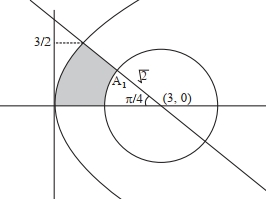
If the area bounded by the curve $2 y^2=3 x$, lines $x+y=3, y=0$ and outside the circle $(x-3)^2+y^2=2$ is $A$, then $4(\pi+4 A )$ is equal to $.........$.
If xy = ex-y then $\frac{\text{dy}}{\text{dx}}$ is:
  1. $\frac{1+\text{x}}{1+\log\text{x}}$
  2. $\frac{1-\log\text{x}}{1+\log\text{x}}$
  3. $\text{Not defined.}$
  4. $\frac{\log\text{x}}{(1+\log\text{x})^2}$
If three vectors $a = 12i + 4j + 3k , b = 8i - 12j - 9k$ and  $c = 33i - 4j - 24k$ represents $a$  cube, then its volume will be
If $f(x)=$  $7{e^{{{\sin }^2}x}} - {e^{{{\cos }^2}x}} + 2$, then,$\sqrt {7{f_{\min }} + {f_{\max }}}$ is equal to
Let $a$ , $b$ , $c$ are non real numbers satisfying equation $x^5 = 1$ and $S$ be the set of all non-invertible matrices of the form $\left[ {\begin{array}{*{20}{c}}
  1&a&b \\ 
  w&1&c \\ 
  {{w^2}}&w&1 
\end{array}} \right],\,\,\,\,w = {e^{\frac{{i\,2\pi }}{5}}}$ . Then the number of distinct matrices in the set $S$ is 
If $A = \left[ {\begin{array}{*{20}{c}}1&2&1\\0&1&{ - 1}\\3&{ - 1}&1\end{array}} \right]$, then