MCQ
The $IUPAC$ name of (figure) is

- ✓$2, 6-$ Dimethylhepta $-2, 5-$ dienoic acid
- B$3, 7-$ Dimethylhepta $-2, 5-$ dienoic acid
- C$1-$ Hydroxy $-2, 6-$ dimethylhepta $-2, 5-$ dienone
- Dnone of these
Generate a complete, print-ready paper with questions like this in minutes — across 16+ boards, with answer keys.
| $Ion$ | $Z ^{ n +}$ | $Z ^{ P +}$ | $Z ^{ n +}$ | $Z ^{ m +}$ | $Z ^{ m +}$ |
| $\lambda^0\left( S cm ^2 mol ^{-1}\right)$ | $50.0$ | $25.0$ | $100.0$ | $80.0$ | $100.0$ |
$\lambda^0$ is the limiting molar conductivity of ions
The plot of molar conductivity $(4)$ of $Z _{ m } X _{ n } v s c ^{1 / 2}$ is given below.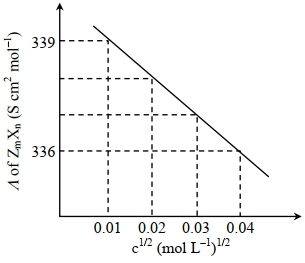
$A$. Hydrogen bonding exists when $\mathrm{H}$ is covalently bonded to the highly electro negative atom.
$B$. Intermolecular $\mathrm{H}$ bonding is present in o-nitro phenol
$C$. Intramolecular $\mathrm{H}$ bonding is present in $\mathrm{HF}$.
$D$. The magnitude of $\mathrm{H}$ bonding depends on the physical state of the compound.
$E$. H-bonding has powerful effect on the structure and properties of compounds.
Choose the correct answer from the options given below :
$(I)$ $ZnCl_2$ is ionic whereas $CdCl_2$ and $HgCl_2$ are covalent
$(II)$ $Zn$ and $Cd$ dissolves in dilute acid $(HCl)$ liberating $H_2$ but $Hg$ can not
$(III)$ $Zn$ and $Cd$ forming with ppt. of $Zn(OH)_2$ and $Cd(OH)_2$ but $Hg$ forms coloured ppt. of
$(IV)$ all from $A_2^{2+}$ type ion
$Al_{(s)}\, | Al^{+3}\, (0.1\,M)||Fe^{+2}\, (0.001\,M)|Fe_{(s)}$
If $E_{A{l^{ + 3}}/Al}^o = - 1.66\,V$ and $E_{Fe/F{e^{ + 2}}}^o = + 0.44\,V$