MCQ
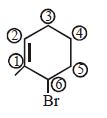
The $IUPAC$ name of given compound is
  • A
    $2-$ Bromo $-1-$ methylcyclohexene
  • $6-$ Bromo $-1-$ methylcyclohexene
  • C
    $1-$ Bromo $-2-$ methylcyclohexene
  • D
    $1-$ Bromo $-2-$ methylcylohex $-2-$ ene
Answer

Correct option: B.
$6-$ Bromo $-1-$ methylcyclohexene
b

Need a full question paper?

Generate a complete, print-ready paper with questions like this in minutes — across 16+ boards, with answer keys.

Start Generating Free

Similar questions

Positive charge in an atom is :
In the reaction :

$2x + B_2H_6 \longrightarrow [BH_2(x)_2]^+ [BH_4]^-$

the amine '$x$' will not be

The rate constant for a first order reaction is $20\,min ^{-1}$. The time required for the initial concentration of the reactant to reduce to its $\frac{1}{32}$ level is $........\times 10^{-2}\,min$. (Nearest integer)(Given: $\quad \ln 10=2.303, \log 2=0.3010)$
Maximum number of different spectral lines which will be obtained when a sample of large number of $H$-atoms in $5^{th}$ excited state makes transition to ground state without emitting any line in Balmer series
Which is the most suitable reagent among the following distinguish compound $(3)$  from the others?

$(1)\,CH_3C \equiv C - CH_3$   $(2)\,CH_3CH_2 -CH_2 -CH_3$

$(3)\, CH_3CH_2C \equiv CH$    $(4)\, CH_3CH = CH_2$

The number of atoms in $0.1\, mol$ of a triatomic gas is $(N_A = 6.02\times10^{23}\, mol^{-1})$
If $5.85\,gms$ of $NaCl$ are dissolved in $90\,gms$ of water, the mole fraction of $NaCl$ is
Answer the following by appropriately matching the lists based on the information given in the paragraph Consider the Bohr's model of a one$-$electron atom where the electron moves around the nucleus. In the following List$-I$ contains some quantities for the $n^{t /}$ orbit of the atom and List$-II$ contains options showing how they depend on $n$. Which of the following options has the correct combination considering List$-I$ and List$-II$?
List$-I$ List$-II$
$(I)$ Radius of the $n^{\text {th }}$ orbit $(P)\propto n ^{-2}$
$(II)$ Angular momentum of the electron in the $n^{\text {th }}$ orbit $(Q)\propto n ^{-1}$
$(III)$ Kinetic energy of the electron in the $n^{\text {th }}$ orbit $(R)\propto n ^0$
$(IV)$ Potential energy of the electron in the $n^{\text {th }}$ orbit $(S)\propto n ^1$
  $(T)\propto n ^2$
  $(U)\propto n ^{1 / 2}$
$(1)$ Which of the following options has the correct combination considering List$-I$ and List$-II$?
$(1) (II), (R)(2) (I), (P)(3) (I), (T)(4) (II), (Q)$
($2$) Which of the following options has the correct combination considering List$-I$ and List$-II$?
$(1) (III), (S)(2) (IV), (Q)(3) (IV),(U)(4) (III), (P)$
Give the answer or quetion $(1)$ and $(2)$
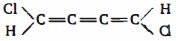
Choose the correct option for the following molecule in view of chemical bonding
Which of the following would undergo dehydration most readily