MCQ
The $IUPAC$ name of given is :
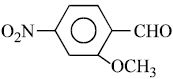
  • $2-$ methoxy $-4-$ nitro benzaldehyde
  • B
    $4-$ nitro anisaldehyde
  • C
    $3-$ methoxy $-4-$ formyl nitro benzene
  • D
    $2-$ formyl $-4-$ nitro anisole

Answer

Correct option: A.
$2-$ methoxy $-4-$ nitro benzaldehyde
a
The rule says that the first priority for the lowest numbers is given to the substituent of highest priority, i.e., $CHO$.

Here, the other group will be taken as a substituent. The numbering of the other groups will be such that the other groups should be on the least numbering.

Hence, the name $2$-Methoxy-$4$-nitro benzaldehyde.

Need a full question paper?

Generate a complete, print-ready paper with questions like this in minutes — across 16+ boards, with answer keys.
Start Generating Free

Similar questions

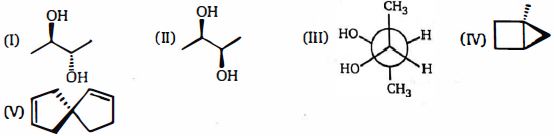
Which of the following molecules are chiral ?
An average person needs about $10000\, \mathrm{~kJ}$ energy per day. The amount of glucose (molar mass $=180.0\, \mathrm{~g} \,\mathrm{~mol}^{-1}$ ) needed to meet this energy requirement is $.....\,\mathrm{g}$.

(Nearest integer)

(Use : $\Delta_{\mathrm{c}} \mathrm{H}($ glucose $)=-2700\, \mathrm{~kJ}\, \mathrm{~mol}^{-1}$ )

Propane cannot be prepared from which reaction
The $pH$ of a simple sodium acetate buffer is given by $pH = p{K_a} + \log \frac{{[Salt]}}{{[Acid]}}$ ${K_a}$ of acetic acid $ = 1.8 \times {10^{ - 5}}$ If [Salt] = [Acid] = $0.1 \,M$, the $pH$ of the solution would be about
Which is not a electrophile
A $20\, litre$ container at $400\, K$ contains $CO_{2(g)}$ at pressure $0.4\, atm$ and an excess of $SrO$ (neglect the volume of solid $SrO$). The volume of the container is now decreased by movingthe movable piston fitted in the container. The maximum volume of the container, when pressure of $CO_2$ attains its maximum value, will be........$litre$

(Given that : $SrCO_{3(s)} \rightleftharpoons  SrO_{(s)}+ CO_{2(g)} \,, K_p=1.6\,atm$)

The isoelectronic pair is
Group comprising of all metals is
Normal butane convert into isobutane by
Determine enthalpy of formation for $H_2O_2(\ell ),$  using listed enthalpies of reaction

${N_2}{H_4}(l)\,+\,2{H_2}{O_2}(l)\,\, \to \,{N_2}(g)\,\, + \,4{H_2}O(l);\,\,{\Delta _r}H_1^o\, = \, - 818\,\,kJ/mol$

${N_2}{H_4}(l)\,\, + {O_2}(g)\,\, \to \,{N_2}(g)\,\, + \,2{H_2}O(l);\,\,{\Delta _r}H_2^o\, = \, - 622\,\,kJ/mol$

${H_2}(g)\,\, + 1/2{O_2}(g)\,\, \to \,{H_2}O(l);\,\,{\Delta _r}H_3^o\, = \, - 285\,\,kJ/mol$

......$kJ/mol$