MCQ
The $IUPAC$ name of the compound is _________.
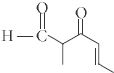
- A$5-$formylhex$-{2-}$en$-{3-}$one
- B$5-$methyl${-4}-$oxohex$-{2-}$en${-5}-$al
- C${3-}$keto$-{2-}$methylhex${-5}-$enal
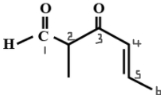
- ✓${3-}$keto$-{2-}$methylhex${-4}-$enal
Generate a complete, print-ready paper with questions like this in minutes — across 16+ boards, with answer keys.
$(I)$ It is easier to remove $2 \mathrm{p}$ electron than $2 \mathrm{s}$ electron
$(II)$ $2 \mathrm{p}$ electron of $\mathrm{B}$ is more shielded from the nucleus by the inner core of electrons than the $2 s$ electrons of $Be.$
$(III)\; 2 s$ electron has more penetration power than $2 \mathrm{p}$ electron.
$(IV)$ atomic radius of $\mathrm{B}$ is more than $\mathrm{Be}$
(Atomic number $\mathrm{B}=5, \mathrm{Be}=4$ )
The correct statements are
Product of the above reaction will be
$A$. $\mathrm{Be} \rightarrow \mathrm{Be}^{-}$
$B$. $\mathrm{N} \rightarrow \mathrm{N}^{-}$
$C$. $\mathrm{O} \rightarrow \mathrm{O}^{2-}$
$D$. $\mathrm{Na} \rightarrow \mathrm{Na}^{-}$
$E$. $\mathrm{Al} \rightarrow \mathrm{Al}^{-}$
Choose the most appropriate answer from the options given below :
Assertion $(A) :$ Treatment of bromine water with propene yields $1-$bromopropan$-2-$ol.
Reason $(R):$ Attack of water on bromonium ion follows Markovnikov rule and results in $1-$bromopropan$-2-$ol.
In the light of the above statements, choose the most appropriate answer from the options given below: