MCQ
The $IUPAC$ name of the compound is
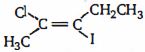
- ✓$trans-2-$ chloro $-3-$ iodo $-2-$ pentene
- B$cis-2-$ chloro $-3-$ iodo $-2-$ pentene
- C$trans -3-$ iodo $-4-$ chloro $-3-$ pentene
- D$cis-3-$ iodo $-4-$ chloro $-3-$ pentene
The parent hydrocarbon contains $5 C$ atom continuous chain with one $C = C$ bond between second and third carbon atom.
Hence, it is named as $2$-pentene.
One $Cl$ and one $I$ are present at second and third carbon atom respectively.
The molecule has trans geometry across $C = C$ bond.
Hence, it is named trans-$2$-chloro-$3$-iodo-$2$-pentene.
Generate a complete, print-ready paper with questions like this in minutes — across 16+ boards, with answer keys.
(IMAGE)
$[A]$ ( $M$ and $O)$ and ( $N$ and $P$ ) are two pairs of diastereomers
$[B]$ Bromination proceeds through trans-addition in both the reactions
$[C]$ $O$ and $P$ are identical molecules
$[D]$ (M and $O)$ and ( $N$ and $P)$ are two pairs of enantiomers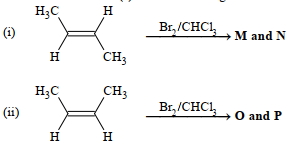
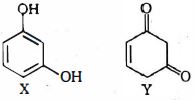
Correct statement is/are
| List $I$ | List $II$ |
| $P$. $\quad \underset{X}{\left( C _2 H _5\right)_3 N }+\underset{ Y }{ CH _3 COOH }$ | $1.$ Conductivity decreases and then increases |
| $Q.$ $\quad \underset{X}{ KI (0.1 M )}+\underset{ Y }{ AgNO _3(0.01 M )}$ | $2.$ Conductivity decreases and then does not change much |
| $R.$ $\quad \underset{X}{ CH _3 COOH }+\underset{ K }{ KOH }$ | $3.$ Conductivity increases and then does not change much |
| $S$. $\quad \underset{X}{ NaOH }+\underset{Y}{ HI }$ | $4.$ Conductivity does not change much and then increases |
Codes: $ \quad P \quad Q \quad R \quad S $