MCQ
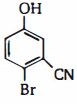
The $IUPAC$ name of the following compound is
- A$4-$ Bromo $-3-$ cyanophenol
- ✓$2-$ Bromo $-5-$ hydroxy benzonitrile
- C$2-$ Cyano $-4-$ hydroxy bromobenzene
- D$6-$ Bromo $-3-$ hydroxy benzonitrile
Now, the lowest set of locant rule is considered.
Number $1$ is given to $- CN$ group, $- Br$ will be at the $2^{\text {nd }}$ position and $- OH$ will be at the $5^{\text {th }}$ position.
So, the name is $2$-bromo-$5$-hydroxybenzonitrile.
Generate a complete, print-ready paper with questions like this in minutes — across 16+ boards, with answer keys.
| Compound | Weight $\%$ of $P$ | Weight $\%$ of $Q$ |
| $1$ | $50$ | $50$ |
| $2$ | $44.4$ | $55.6$ |
| $3$ | $40$ | $60$ |
$(A)$ If empirical formula of compound $3$ is $P_3 Q_4$, then the empirical formula of compound $2$ is $P_3 Q_5$.
$(B)$ If empirical formula of compound $3$ is $P _3 Q _2$ and atomic weight of element $P$ is $20$ , then the atomic weight of $Q$ is $45$ .
$(C)$ If empirical formula of compound $2$ is $PQ$, then the empirical formula of the compound $1$ is $P _5 Q _4$.
$(D)$ If atomic weight of $P$ and $Q$ are $70$ and $35$ , respectively, then the empirical formula of compound $1$ is $P _2 Q$.
$1$. $NH_3 + NH_4Cl$
$2$. $HCl + NaCl$
$3$. $NH_3 + HCl$ in $2 : 1$ $mole$ ratio
Select the correct answer using the code given below
Identify the adduct.