MCQ
The $IUPAC$ name of
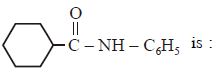
  • A
    $N-$ Cyclohexyl benzamide
  • B
    $N-$ Phenyl $-N-$ cyclohexylmethanamide
  • $N-$ Phenylcyclohexane carboxamide
  • D
    $N-$ Cyclohexyl $-N-$ phenylmethylamide
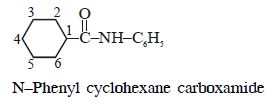
Answer

Correct option: C.
$N-$ Phenylcyclohexane carboxamide
c

Need a full question paper?

Generate a complete, print-ready paper with questions like this in minutes — across 16+ boards, with answer keys.

Start Generating Free

Similar questions

Weight $(g )$ of two moles of the organic compound, which is obtained by heating sodium ethanoate with sodium hydroxide in presence of calcium oxide is :
Predict the correct intermediate and product in the following reaction :

${H_3}C - C \equiv CH\,\xrightarrow[{HgS{O_4}}]{{{H_2}O,\,{H_2}S{O_4}}}\,\mathop {Intermediate}\limits_{(A)} \,$$ \to \,\mathop {\Pr oduct}\limits_{(B)} $
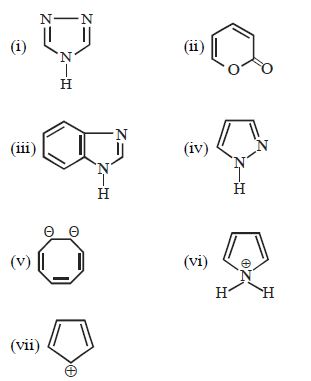
Identify the number of aromatic compounds
The longest wavelength of light that can be used for the ionisation of lithium atom $(Li)$ in its ground state is $x \times 10^{-8}\, m$. The value of $x$ is $.....$  (Nearest Integer)

(Given : Energy of the electron in the first shell of the hydrogen atom is $-2.2 \times 10^{-18} \,J$; $h =6.63 \times 10^{-34}\, Js$ and $c =3 \times 10^{8} \,ms ^{-1}$ )

Total number of $\alpha$ -hydrogen in given compound is
The rate constant for forward and backward reactions of hydrolysis of ester are $1.1 \times {10^{ - 2}}$ and $1.5 \times {10^{ - 3}}$ per minute respectively. Equilibrium constant for the reaction is $C{H_3}COO{C_2}{H_5} + {H_2}O$ $\rightleftharpoons$ $C{H_3}COOH$ $ + {C_2}{H_5}OH$
The first ionisation energy of oxygen is less than that of nitrogen. Which of the following is  the correct reason for this observation :-
Intermediated formed in the reaction $P$ and $Q$ is

$P.$    $C{H_3} - CH = C{H_2}\xrightarrow{{HCl}}$

$Q.$   $C{H_3} - CH = C{H_2}\xrightarrow[{{\text{Peroxide}}}]{{HCl}}$

For which of the following reactions, the degree of dissociation cannot be calculated from the vapour density data

$(I)$ $2HI(g) \rightleftharpoons {H_2}(g)\, + \,{I_2}(g)$

$(II)$ $2N{H_3}(g) \rightleftharpoons {N_2}(g)\, + \,3{H_2}(g)$

$(III)$ $2NO(g) \rightleftharpoons {N_2}(g)\, + \,{O_2}(g)$

$(IV)$ $PC{l_5}(g) \rightleftharpoons PC{l_3}(g)\, + \,C{l_2}(g)$

Which of the following can show resonance