MCQ
The $IUPAC$ nomenculature of $(CH_3)_3C-CH=C(CH_3)_2$ is
  • A
    $2,4,4-$ Trimethylpent $-3-$ ene
  • $2,4,4-$ Trimethylpent $-2-$ ene
  • C
    $2,2,4-$ Trimethylpent $-3-$ ene
  • D
    $2,2,4-$ Trimethylpent $-2-$ ene

Answer

Correct option: B.
$2,4,4-$ Trimethylpent $-2-$ ene
b
$\begin{array}{*{20}{c}}
  {\,\,\,\,\,\,\,\,C{H_3}\,\,\,\,\,\,\,\,\,\,\,\,\,\,\,\,\,\,\,C{H_3}\,} \\ 
  {|\,\,\,\,\,\,\,\,\,\,\,\,\,\,\,\,\,\,\,\,\,\,\,\,\,\,\,\,|} \\ 
  {\mathop C\limits_5 {H_3} - \mathop C\limits_4  - \mathop C\limits_3 H = \mathop C\limits_2  - \mathop C\limits_1 {H_3}} \\ 
  {|\,\,\,\,\,\,\,\,\,\,\,\,\,\,\,\,\,\,\,\,\,\,\,\,\,\,\,\,\,} \\ 
  {\,\,\,\,\,\,\,\,\,\,\,\,\,\,\,\,\,\,C{H_{3\,\,\,\,\,\,\,\,\,\,\,\,\,\,\,\,\,\,\,\,\,\,\,\,\,\,\,\,\,\,\,\,\,\,\,\,\,\,\,\,\,\,\,\,\,\,\,}}} 
\end{array}$

$2,4,4-Trimethylpent-2-ene$

Need a full question paper?

Generate a complete, print-ready paper with questions like this in minutes — across 16+ boards, with answer keys.
Start Generating Free

Similar questions

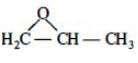
The $IUPAC$ name of the compound  $[Figure]$   is  
$1\,mol$ of oxygen gas are heated at constant volume from $20\,^oC$ to $30\,^oC$ . What will be change in the internal energy of gas? Molar heat capacity of oxygen at constant pressure, $ C_P= 7.03\,cal\,mol^{-1}\,K^{-1}$ and $R = 2\,cal\,mol^{-1}\,K^{-1}$ ? .....$cal$
Zinc reacts with hydrochloric acid to give hydrogen and zinc chloride. The volume of hydrogen gas produced at $STP$ from the reaction of $11.5\,g$ of zinc with excess $HCl$ is $..........L$ (Nearest integer) (Given : Molar mass of $Zn$ is $65.4\,g\,mol ^{-1}$ and Molar volume of $H _2$ at $STP =22.7\,L$ )
Which of the following compounds will form a hydrocarbon on reaction with Grignard reagent
Among the statements $(I - IV),$ the correct ones are:

$(I)$ $Be$ has smaller atomic radius compared to $Mg$

$(II)$ $Be$ has higher ionization enthalpy than $Al.$

$(III)$ Charge/radius ratio of $Be$ is greater than that of $Al$.

$(IV)$ Both Be and $Al$ form mainly covalent compounds.

Given

$(A)\, n = 5, m_l= + 1$
$(B)\, n =2,  l =1, m_l= -1, m_s = -1/2$
The maximum number of electron$(s)$ in an atom that can have the quantum numbers as given in $(A)$ and $(B)$ are respectively

The correct stability order for $N_2$ and its given ions is :-
A chemical reaction is catalyzed by a catalyst $X$. Hence $X$
If radius of second Bohr orbit of the $He ^{+}$ion is $105.8\,pm$, what is the radius of third Bohr orbit of $Li ^{2+}$ ion?
If $1 L$ of $O_2$​ at $15^\circ C$ and $750\ mm$ pressure contains $N$ molecules, the number of molecules in $2 L$ of $\ce{SO_2}$​ under the same conditions of temperature and pressure will be :