Question
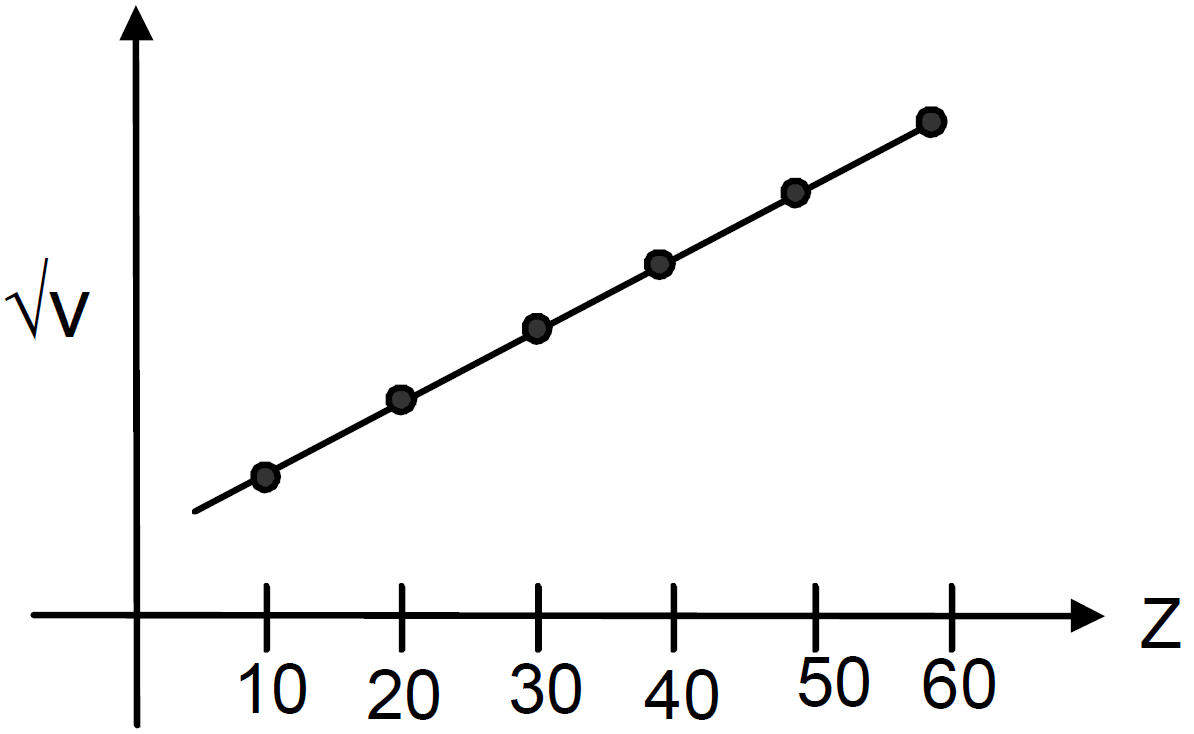
The $\text{K}_\beta$ X-rays from certain elements are given below. Draw a Moseley-type plot of $\sqrt{\text{v}}$ versus Z for $\text{K}_\beta$ radiation.
Element
Ne
P
Ca
Mn
Zn
Br
Energy (keV)
0.858
2.14
4.02
6.51
9.57
13.3

Answer

$\text{K}_\text{B}$ radiation is when the e jumps from

n = 3 to n = 1 (here n is principal quantum no)

$\Delta\text{E}=\text{hv}=\text{Rhc(z-h)}^2\Big(\frac{1}{2^2}-\frac{1}{3^2}\Big)$

$\sqrt{\text{v}}=\sqrt{\frac{9\text{RC}}{8}}(\text{z}-\text{h})$

$\therefore\sqrt{\text{v}}\propto\text{z}$

Second method :

We can directly get value of v b

hv = Energy

$\Rightarrow\text{v}=\frac{\text{Energy(in Kev)}}{\text{h}}$

This we have to find out $\sqrt{\text{v}}$ and draw the same graph as above.

Need a full question paper?

Generate a complete, print-ready paper with questions like this in minutes — across 16+ boards, with answer keys.

Start Generating Free

Similar questions

A beam of monochromatic light of wavelength $\lambda$ ejects photoelectrons from a cesium surface $\big(\Phi=1.9\text{eV}\big).$ These photoelectrons are made to collide with hydrogen atoms in ground state. Find the maximum value of $\lambda$ for which (a) hydrogen atoms may be ionized, (b) hydrogen atoms may get excited from the ground state to the first excited state and (c) the excited hydrogen atoms may emit visible light.
Consider a particle moving in simple harmonic motion according to the equation $\text{x}=2.0\cos(50\pi\text{t}+\tan^{-1}0.75)$ where x is in centimetre and t in second. The motion is started at t = 0.
  1. When does the particle come to rest for the first time?
  2. When does the acceleration have its maximum magnitude for the first time?
  3. When does the particle come to rest for the second time?
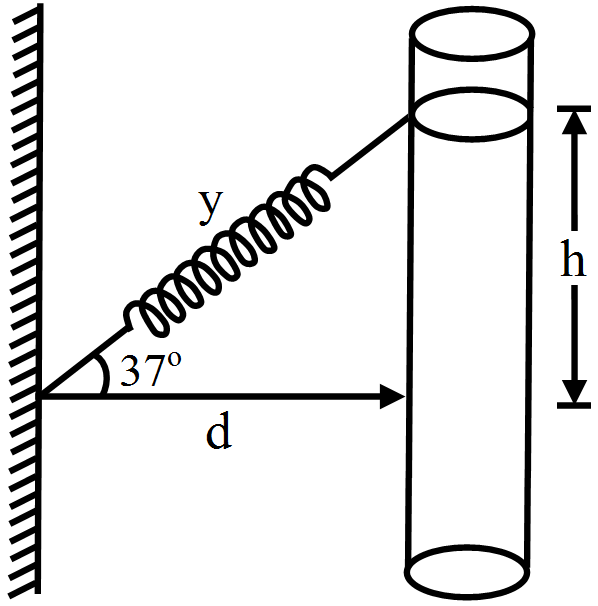
One end of a light spring of natural length d and spring constant k is fixed on a rigid wall and other end is fixed in a smooth ring of mass m as shown in figure. Initially, the spring is stretched such that it makes an angle of 37° with the horizontal.

Now, the ring is stretched from rest, find the speed of the ring when it will become horizontal, assume that ring slides on the vertical wall without friction.

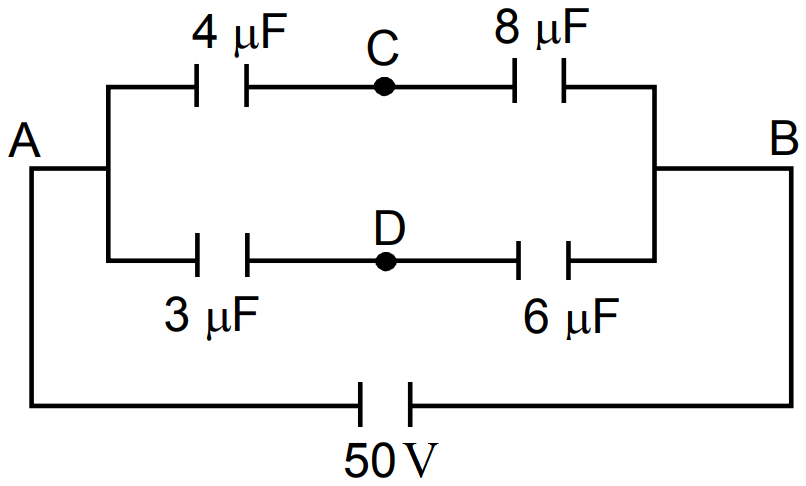
Take the potential of the point B in figure to be zero:
  1. Find the potentials at the points C and D.
  2. If a capacitor is connected between C and D, what charge will appear on this capacitor?

A small block of mass 200g is kept at the top of a frictionless incline which is 10m long and 3.2m high. How much work was required.
  1. To lift the block from the ground and put it at the top.
  2. To slide the block up the incline? What will be the speed of the block when it reaches the ground.
  3. It falls off the incline and drops vertically on the ground.
  4. It slides down the incline? Take g = 10m/s2.
A chain of length l and mass m lies on the surface of a smooth sphere of radius R>1 with one end tied to the top of the sphere.
  1. Find the gravitational potential energy of the chain with reference level at the centre of the sphere.
  2. Suppose the chain is released and slides down the sphere. Find the kinetic energy of the chain, when it has slid through an angle $\theta.$
  3. Find the tangential acceleration $\frac{\text{dv}}{\text{dt}}$ of the chain when the chain starts sliding down.
A stone is thrown vertically upward with a speed of 28m/s.
  1. Find the maximum height reached by the stone.
  2. Find its velocity one second before it reaches the maximum height.
  3. Does the answer of part.
  4. Change if the initial speed is more than 28m/s suchas 40m/s or 80m/s?
Suppose the block of the previous problem is pushed down the incline with a force of 4N. How far will the block move in the first two seconds after starting from rest? The mass of the block is 4kg.
A spaceship is stationed on Mars. How much energy must be expended on the spaceship to launch it out of the solar system? Mass of the space ship = 1000kg; mass of the sun = 2 × 1030kg; mass of mars = 6.4 × 10²³kg; radius of mars = 3395km; radius of the orbit of mars = 2.28 × 10⁸km; G = 6.67 × 10⁻¹¹N m2 kg-2.
What is meant by beats? Discuss graphical method of formation of beats.