MCQ
The K.E. of a body can be increased maximum by doubling its:
  • A
    Mass
  • B
    Weight
  • C
    Speed
  • D
    Density

Answer

  1. Speed

Explanation:

$\text{K.E}=\frac{1}{2}\text{mv}^2$

$\text{K.E}\propto\text{m}\text{ &}\text{ K.E}\propto\text{v}^2$

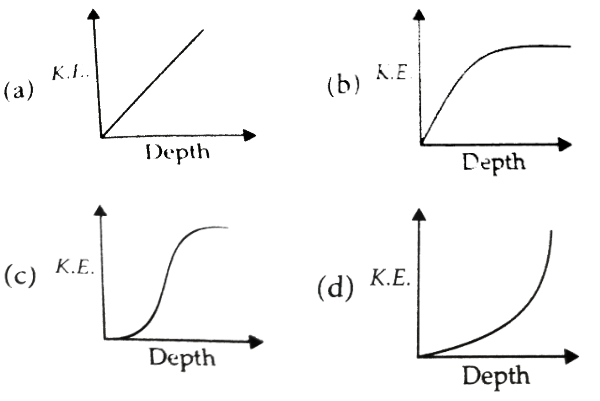
So doubling mass will double the kinetic energy and doubling speed will make kinetic energy 4 times.

Need a full question paper?

Generate a complete, print-ready paper with questions like this in minutes — across 16+ boards, with answer keys.

Start Generating Free

Similar questions

The transverse displacement $y(x, t)$ of a wave on a string is given by $y(x, t)=e^{-\left(a x^2+b t^2+2 \sqrt{a b} x t\right)}$ This represents a
A vertical cylinder with heat-conducting walls is closed at the bottom and is fitted with a smooth light piston. It contains one mole of an ideal gas. The temperature of the gas is always equal to the surrounding’s temperature, $T_0$. The piston is moved up slowly to increase the volume of the gas to $\eta$ times. Which of the following is incorrect?
Given below are two statements:

Statement $I:$ A truck and a car moving with same kinetic energy are brought to rest by applying brakes which provide equal retarding forces. Both come to rest in equal distance.

Statement $II:$ A car moving towards east takes a turn and moves towards north, the speed remains unchanged. The acceleration of the car is zero.

In the light of given statements, choose the most appropriate answer from the options given below.
The specific heat of the mixture of two gases at constant volume is $\frac {13}{6}\,R$ . The ratio of number of moles of first gas to second is $1 : 2$. The respective gases may be
The initial pressure of a gas is P. It is adiabatic compressed due to which its density becomes four times its initial density. The final pressure of the gas will be: ${\gamma = 1.5}$
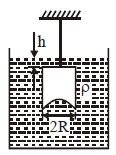
A hemispherical portion of radius $R$ is removed from the bottom of a cylinder of radius $R$. The volume of the remaining cylinder is $V$ and mass $M$. It is suspended by a string in a liquid of density $\rho$, where it stays vertical. The upper surface of cylinder is at a depth $h$ below the liquid surface. The force on the bottom of the cylinder by the liquid is
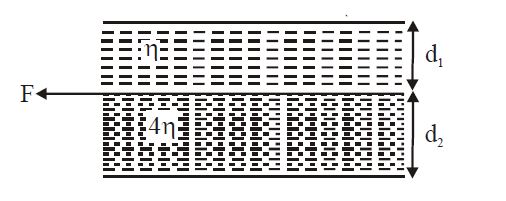
A thin plate separates two liquids of coefficients of viscosity $\eta$ and $4\ \eta$ kept between two fixed plates as shown. If plate has to be pulled by applying minimum force then $\frac{d_2}{d_1}$ is
Two spheres of masses m and M are situated in air and the gravitational force between them is F. The space around the masses is now filled with liquid of specific gravity 3. The gravitational force will now be:
A car $'A'$ chasing another car $'B'$ with a speed of $20\, m/s$ sounding a horn of $180\, Hz$. While both cars are moving towards a stationary siren of frequency $170\, Hz$. What is the speed of car $B$ so that it can't hear any beat ....$m/s$ (speed of sound $= 340\, m/s$)