MCQ
The $L C$ parallel resonant circuit
  • has a very high impedance
  • B
    has a very high current
  • C
    acts as resistance of very low value
  • D
    has zero impedance

Answer

Correct option: A.
has a very high impedance
(a) : The $L C$ parallel resonant circuit has a very high impedance, hence a very low current.

Need a full question paper?

Generate a complete, print-ready paper with questions like this in minutes — across 16+ boards, with answer keys.
Start Generating Free

Similar questions

By adding soluble impurity in a liquid, angle of contact
The angle made by orbital angular momentum of electron with the direction of the orbital magnetic moment is
Light of wavelength $\lambda$ which is less than threshold wavelength is incident on a photosensitive material. If incident wavelength is decreased so that emitted photoelectrons are moving with some velocity then stopping potential will
A disc of moment of inertia $I_1$ is rotating in horizontal plane about an axis passing through a centre and perpendicular to its plane with constant angular speed $\omega_1$. Another disc of moment of inertia $I_2$ having zero angular speed is placed coaxially on a rotating disc. Now both the discs are rotating with constant angular speed $\omega_2$. The energy lost by the initial rotating disc is
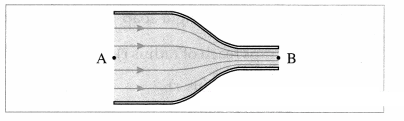
Water flows in a streamlined flow through the pipe shown in the following figure. The pressure:Image
Sensitivity of moving coil galvanometer is $s$. If a shunt of $\left(\frac{1}{8}\right)^{\text {th }}$ of the resistance of galvanometer is connected to moving coil galvanometer, its sensitivity becomes
A photoelectric surface is illuminated successively by monochromatic light of wavelength $\lambda$ and $\lambda / 2$. If the maximum kinetic energy of the emitted photoelectrons in the second case is 3 times that in the first case, the work function of the surface is,
In the formation of beats, the resultant amplitude varies with a frequency equal to
If the ratio of the intensities of two waves producing interference is $49: 16$, then the ratio of the resultant maximum intensity to minimum intensity will be
A thin uniform rod of mass $3 \mathrm{~kg}$ and length $2 \mathrm{~m}$ rotates about an axis through its $\mathrm{CM}$ and perpendicular to its length. An external torque changes its frequency by $15 \mathrm{~Hz}$ in $10 \mathrm{~s}$. The magnitude of the torque is