MCQ
The laws of thermodynamics speak about:
  • A
    Rates of chemical changes
  • B
    Feasibility and energy transformations of a Process
  • C
    Both the rate and energy changes of a process
  • D
    Energy changes in chemical reactions only

Answer

  1. Feasibility and energy transformations of a Process

Explanation:

Thermodynamics laws are about energy transformation of a process and feasibility of a process.


Need a full question paper?

Generate a complete, print-ready paper with questions like this in minutes — across 16+ boards, with answer keys.
Start Generating Free

Similar questions

What will be hydrogen ion concentration in moles $litr{e^{ - 1}}$ of a solution, whose $pH$ is $ 4.58$
Which statement is incorrect
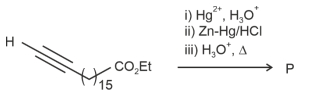
In the following reaction sequence, the major product $P$ is formed.  Glycerol reacts completely with excess $P$ in the presence of an acid catalyst to form $Q$. Reaction of $Q$ with excess $NaOH$ followed by the treatment with $CaCl _2$ yields $Ca$-soap $R$, quantitatively. Starting with one mole of $Q$, the amount of $R$ produced in gram is. . . . [Given, atomic weight: $H =1, C =12, N =14, O =16, Na =23, Cl =35, Ca =40$ ]
Marsh gas is:
The atomic number of the element unnilennium is
Energy hidden in a definite quantity of substance is:
In which of the following arrangements the order is $NOT$ according to the property indicated against it ?
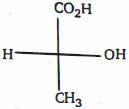
How many representations of lactic acid are possible in Fischer projection $(d $ & $l)$ ?
$C _6 H _5 CH _2 OH$ and $C _6 H _5- O - CH _3$ are :
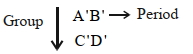
Consider the following elements.

Which of the following is/are true about $\mathrm{A}^{\prime}, \mathrm{B}^{\prime}, \mathrm{C}^{\prime}$ and $\mathrm{D}^{\prime}$ ?

$A$. Order of atomic radii: $\mathrm{B}^{\prime}<\mathrm{A}^{\prime}<\mathrm{D}^{\prime}<\mathrm{C}^{\prime}$

$B$. Order of metallic character: $\mathrm{B}^{\prime}<\mathrm{A}^{\prime}<\mathrm{D}^{\prime}<\mathrm{C}^{\prime}$

$C$. Size of the element : $\mathrm{D}^{\prime}<\mathrm{C}^{\prime}<\mathrm{B}^{\prime}<\mathrm{A}^{\prime}$

$D$. Order of ionic radii : $\mathrm{B}^{\prime+}<\mathrm{A}^{\prime+}<\mathrm{D}^{\prime+}<\mathrm{C}^{\prime+}$

Choose the correct answer from the options given below :